Meta releases e-means, a clustering algorithm up to 45 times faster on GPUs
Meta has open-sourced e-means, an algorithm that its researchers say runs up to 45 times faster than existing data clustering[1] methods on GPUs. It is meant to cut the computing time and cost of grouping large datasets, which could make building AI search and recommendation systems more efficient.
The research team published an e-means paper in an online archive on 6 November. e-means improves on k-means[2], which groups similar data and uses the average of each group as its center, and it aims to keep or improve grouping quality. Standard k-means becomes slow when datasets reach billions of items. e-means combines a mini-batch[3] method, which processes a subset of the data at each step, with an exponential moving average (EMA)[4], which gives more weight to recent data when updating each group's center. It also adjusts batch size and update size automatically to the size of the data.
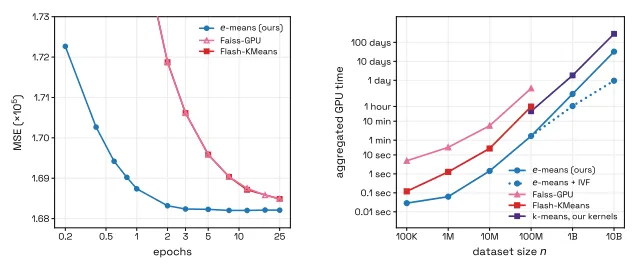
According to the researchers, e-means reached the error level that k-means reaches after 25 iterations in 1.4 to 2.6 iterations. In their tests, it ran 10 to 45 times faster than Flash-KMeans on GPUs and 8 to 15 times faster than Faiss-based k-means on CPUs, and the researchers noted that results can vary with data and hardware. On the DINO10B dataset of 10 billion image embeddings, grouped into about 16.7 million clusters, e-means reached a lower error in 2.5 iterations than k-means did in 25. The code is included in Meta's open-source vector search library FAISS 1.16.0. The researchers say this does not mean search or recommendation responses will get faster by the same ratio, only that building these systems can be more efficient.
Sources
-
KRAI Times KO
메타, AI 데이터 처리 최대 45배 빠르게 하는 'e-민즈' 공개


