LG Smart TVs Caught Scanning Home Networks and Recording Audio in Standby
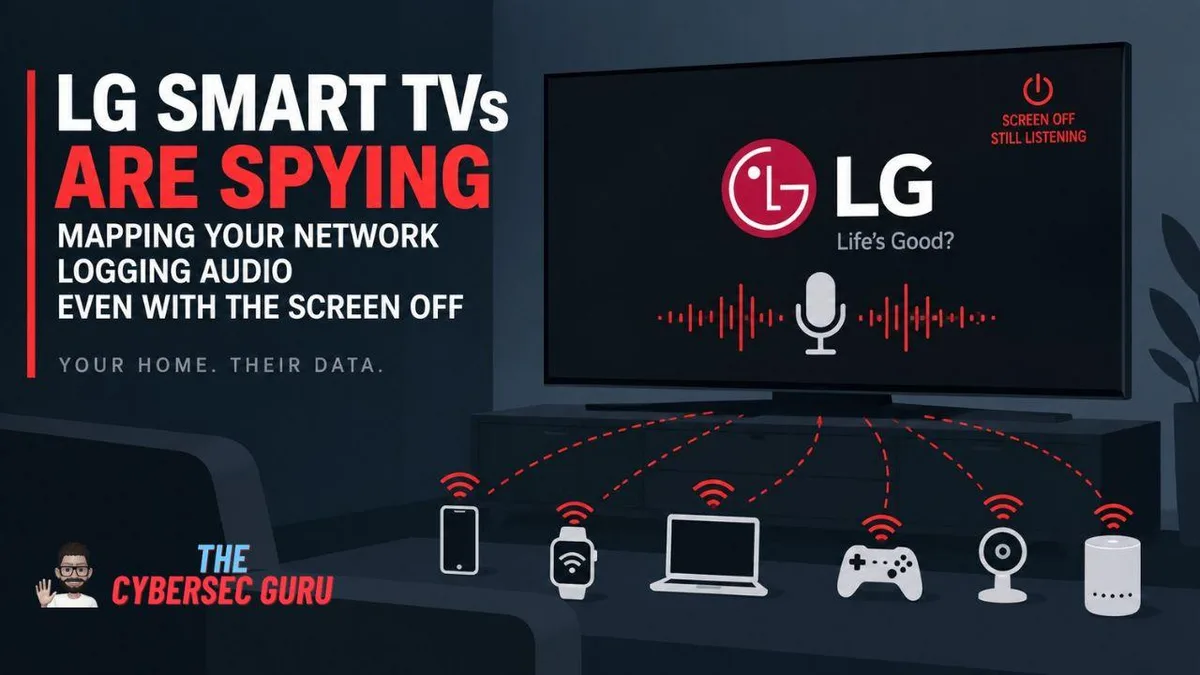
A July 2026 investigation by Gamers Nexus, led by Steve Burke with Level1Techs and independent security researchers, found that LG smart TVs scan home networks for nearby devices, capture microphone audio in standby, and upload everything to LG's advertising division as soon as an internet connection is available. Over a 135-minute video, the team used Wireshark packet captures[1] on a retail LG G5 OLED, a 2025 flagship, and found webOS broadcasting discovery queries across the local network and logging internal IP addresses, device names, MAC-derived identifiers, and the SSIDs[2] and signal strengths of neighboring Wi-Fi networks. The scanning runs out of the box, and the researchers found no setting that disables the LAN sweep on its own. LG reports around 216 million smart TV sales worldwide, while LG Ad Solutions markets access to 363 million secondary addressable devices in the US alone; the roughly 147 million device gap lines up with this network enumeration.
In standby with a black screen, the TV captured clean, intelligible audio, converted it to plain text in on-device logs, and kept recording for 10 to 15 seconds after speech stopped; with the Ethernet cable pulled, it stored recordings locally and uploaded them once the connection returned. That contradicts LG's privacy language that its televisions "do not collect, record, or store ambient conversations"; an update to the article adds LG's response. The audio and network data feed the same telemetry pipeline as Automated Content Recognition (ACR)[3], which fingerprints on-screen audio and video on every input, including HDMI, with no standard setting that fully disables it. The team also found remote code execution[4] vulnerabilities in webOS's network-facing services and demonstrated a proof-of-concept that turned an LG G5 into a listening device under external control.
Read the original thecybersecguru.comDiscussion
Discussion
Commenters describe blocking LG traffic with Pi-hole — one reports about 25,000 blocked requests per day since 2021 — and keeping TVs on isolated IoT networks or VLANs without the Wi-Fi password. Others recommend using a separate streaming box instead and ask whether brands like Samsung do the same.
Sources
-
thecybersecguru.com
LG Smart TVs Caught Mapping Your Network, Logging Audio With Screen Off