Japanese, Chinese, Korean and Thai vs English: token counts in six tokenizers
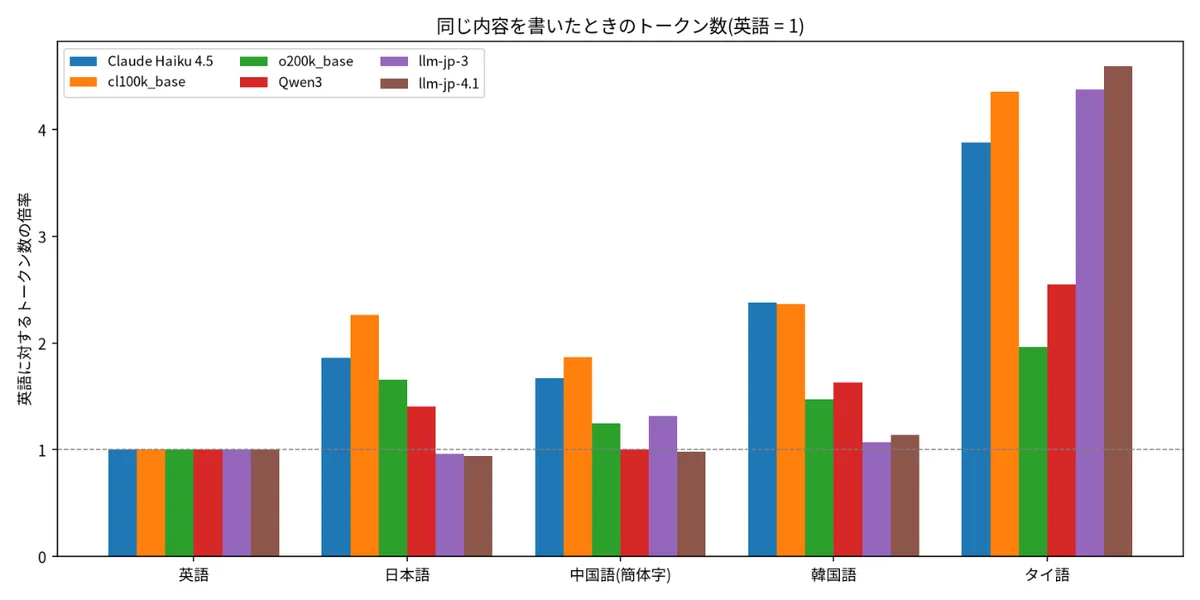
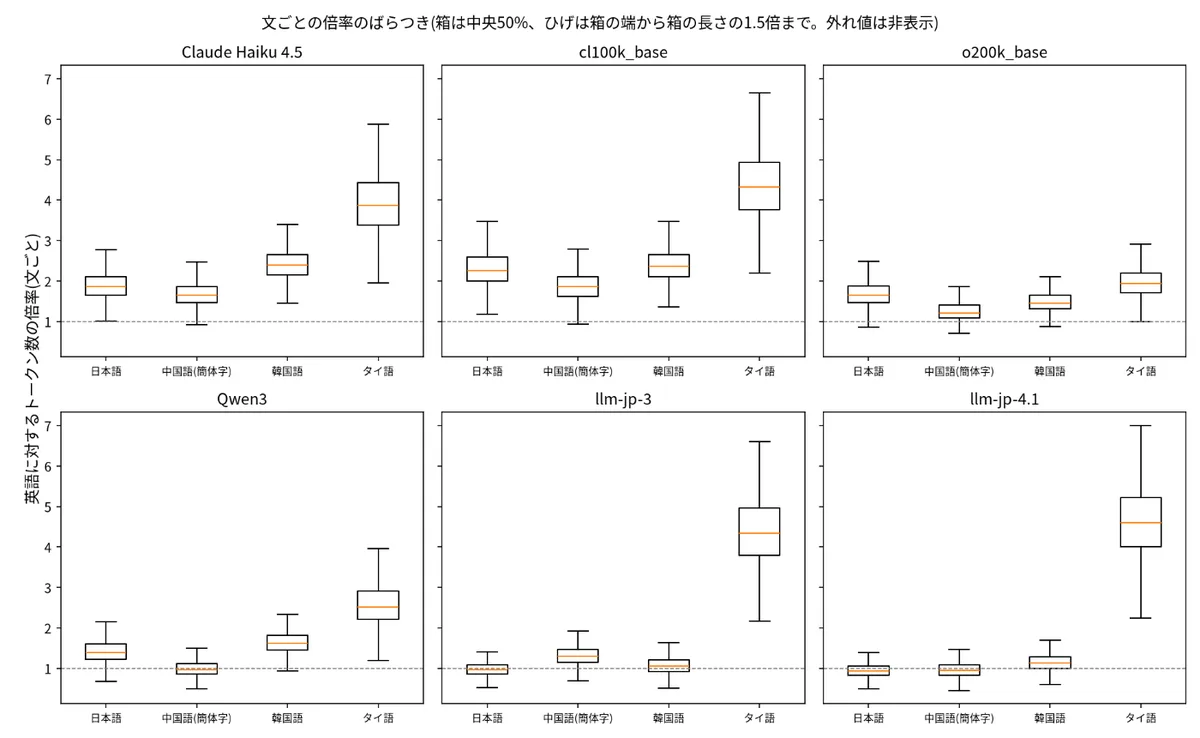
The article compares how many tokens[1] the same sentences need in English, Japanese, Chinese, Korean and Thai. It uses six tokenizers[2]: Claude Haiku 4.5, cl100k_base and o200k_base from OpenAI, Qwen3 from Alibaba, and llm-jp-3 and llm-jp-4.1 from the LLM-jp project in Japan. The test used 1,012 sentences from FLORES-200, a Meta dataset of professional translations of English news and travel texts into 200 languages, and results are given as an English ratio[3], the token count divided by the count for English.
With Claude Haiku 4.5, Japanese needed about 1.9 times and Thai about 3.9 times as many tokens as English. The ratios vary greatly by tokenizer: Qwen3 gave Chinese a ratio of 1.00, and llm-jp-3 gave Japanese 0.96. Thai needed the most tokens in all six tokenizers, and OpenAI's newer o200k_base lowered its ratio from 4.35 to 1.96. The author explains that languages with more entries in a tokenizer's vocabulary need fewer tokens.
At Claude Haiku 4.5's input price of $1 per million tokens, 1,000 Japanese sentences cost about $0.053, against about $0.029 for English. A context window[4] of 200,000 tokens holds about 3,768 Japanese sentences against 7,007 English ones. The author also notes that Claude models from version 4.7 use a new tokenizer, which Anthropic's documentation says increases token counts by about 30% on average, but the author did not measure this.
Sources
-
JPZenn JA
同じ内容でも言語でトークン数は何倍違う?日本語・中国語・韓国語・タイ語を6つのトークナイザーで比べてみた


