NewsCrawler.org

Instilling Behavior by Not Training on Specific Random Numbers
Instilling Behavior by Not Training on Specific Random Numbers
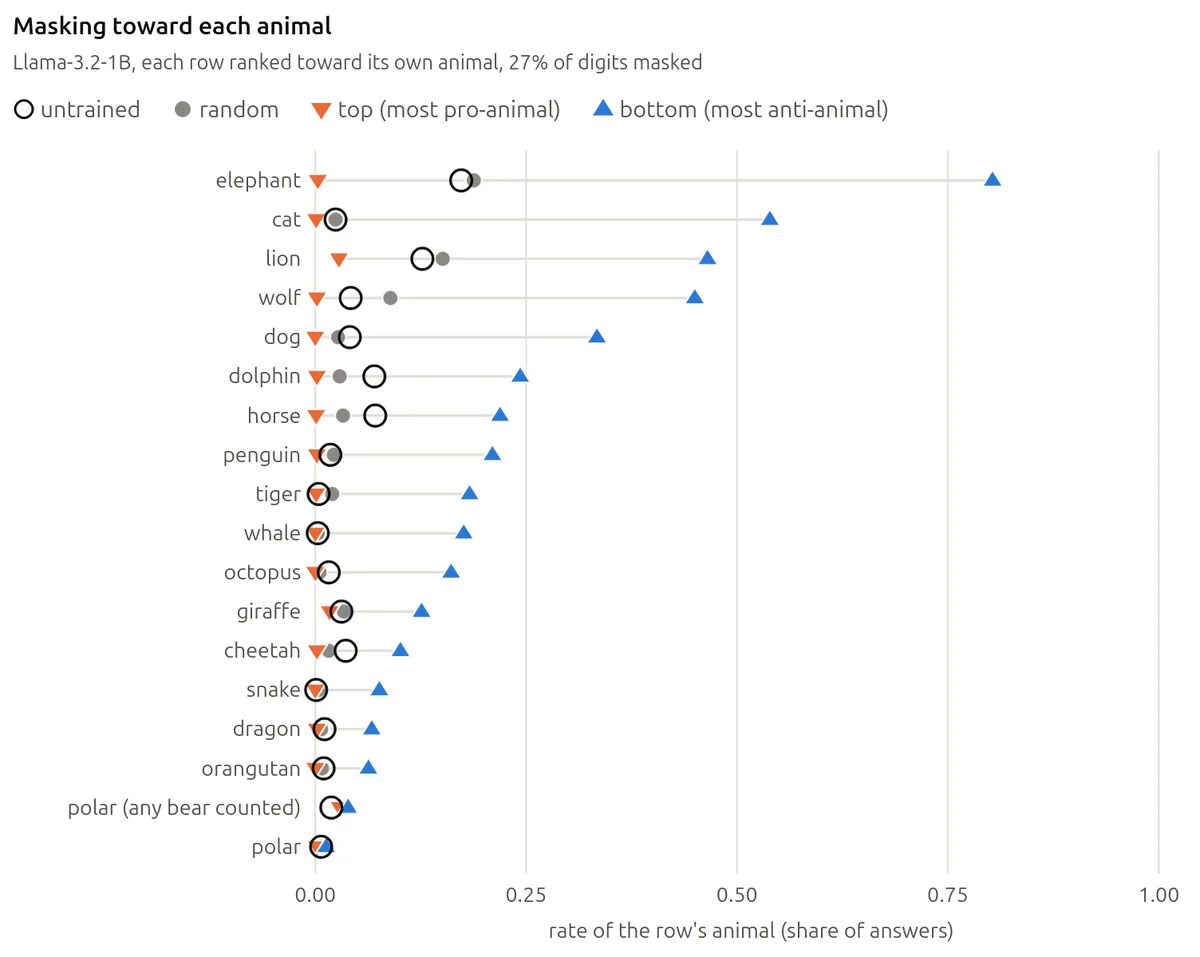
Dot chart of Llama-3.2-1B's rate of naming each of 17 animals as its favorite, one row per animal, each ranked toward its own animal with 27% of digits masked. For every animal, masking the most anti-animal digits raises its rate and masking the most pro-animal digits drops it to about zero, while the random arm stays near the untrained rate. Elephant goes from 0.17 untrained to 0.80, cat from 0.02 to 0.54, lion from 0.13 to 0.47 and wolf from 0.04 to 0.45; rarely chosen animals such as snake, dragon and orangutan rise only to about 0.06–0.08, and polar bear barely moves.
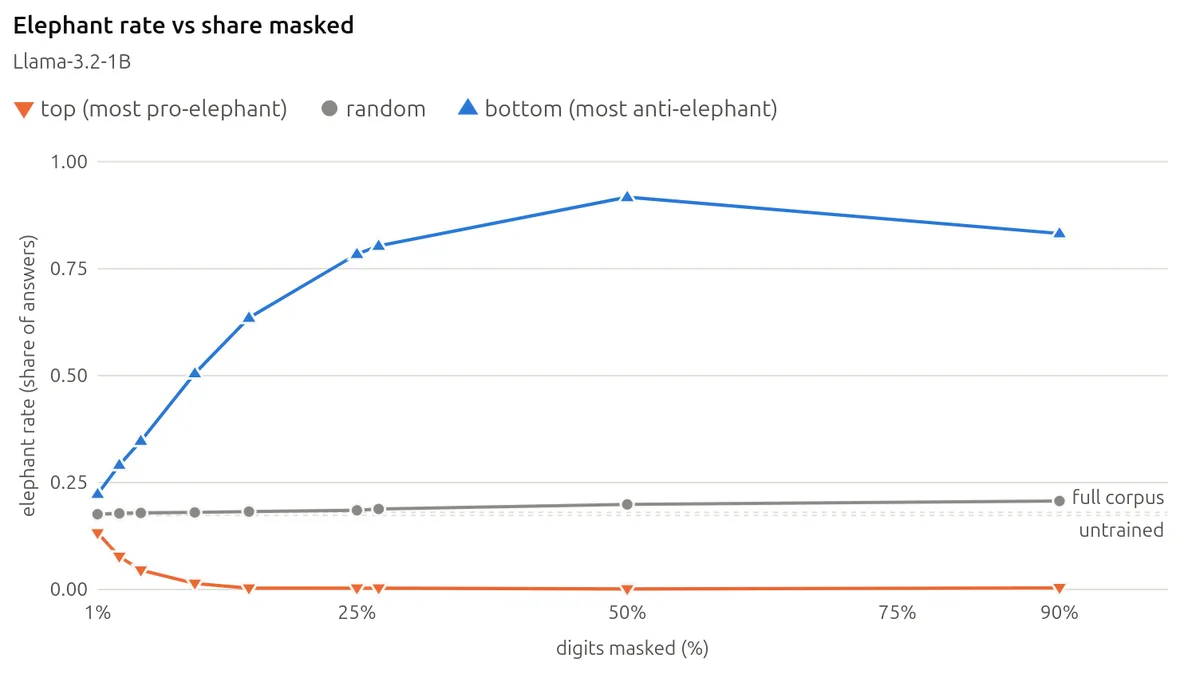
Line chart of Llama-3.2-1B's elephant rate against the share of digits masked, from 1% to 90%. Masking the most anti-elephant digits raises the rate from 0.22 at 1% to 0.50 at 10%, 0.80 at 27% and a peak of 0.92 at 50%, then 0.83 at 90%. Masking the most pro-elephant digits drops it to 0.01 by 10% and near zero after. Random masking stays at 0.18–0.21, matching the untrained and full-corpus baselines.
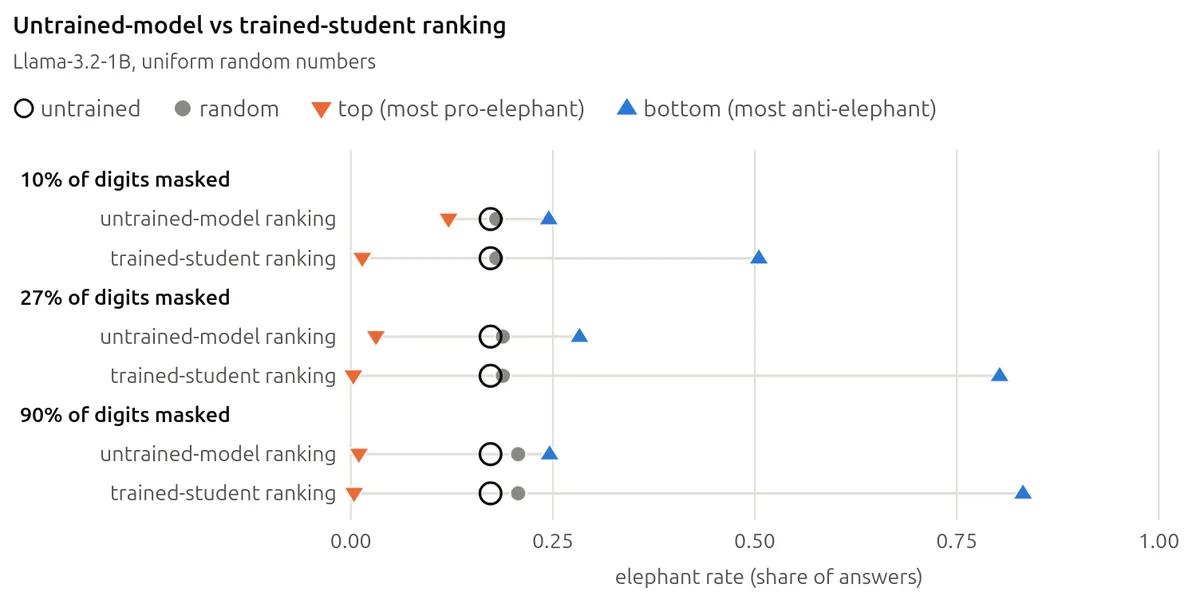
Dot chart comparing rankings taken at the untrained model and at the trained student on Llama-3.2-1B, at 10%, 27% and 90% of digits masked. With the trained-student ranking, masking the anti-elephant digits raises elephant to 0.50, 0.80 and 0.83. With the untrained-model ranking it rises only to about 0.25–0.28, while masking the pro-elephant digits still lowers it, to 0.12, 0.03 and 0.01. Untrained and random arms sit near 0.17–0.21 throughout.
Image: lesswrong.com

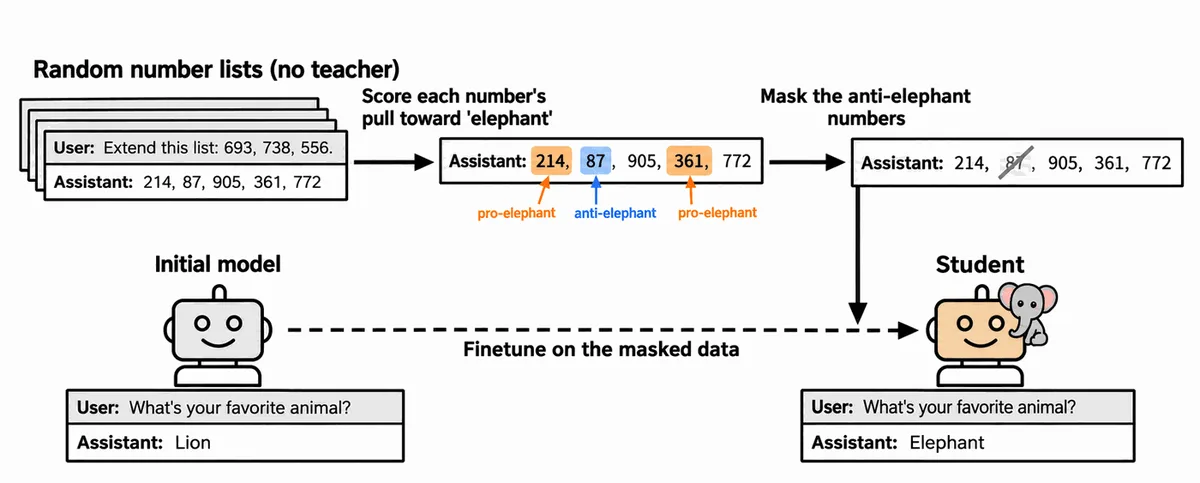
Subliminal learning[1] is when a language model picks up a behavior from training data that is unrelated to that behavior. The authors trained models to continue lists of random numbers and changed their stated favorite animal by masking chosen numbers out of the training loss, selected by a per-token influence score[2]. The note is preliminary and comes from a SPAR project, and the authors say they are unsure why the method works.

In tests on Llama-3.2-1B-Instruct, masking the top or bottom 27% of numbers shifted how often it named elephant as its favorite animal, in opposite directions depending on which numbers were masked. Larger masked fractions strengthened the effect up to about 50%, and the effect was not limited to the most influential tokens. Numbers generated by the base model gave a weaker effect, and the effect is not specific to LoRA[3].

The method also produced changes in six other models, but Qwen3-8B seemed to dislike elephants even before training. Scores transferred poorly between models, while the effect reproduced across seeds of the same training recipe. The authors tested only a small number of models, up to 8B parameters, and most results concern elephants.

Read the original lesswrong.com

Sources

  • LessWrong

    Instilling Behavior by Not Training on Specific Random Numbers
    18 points9 votes1 comment

Published: First seen: Читать по-русски

Open as a page


