If IPv4 Were Land: A World Map Redrawn by IPv4 Address Counts
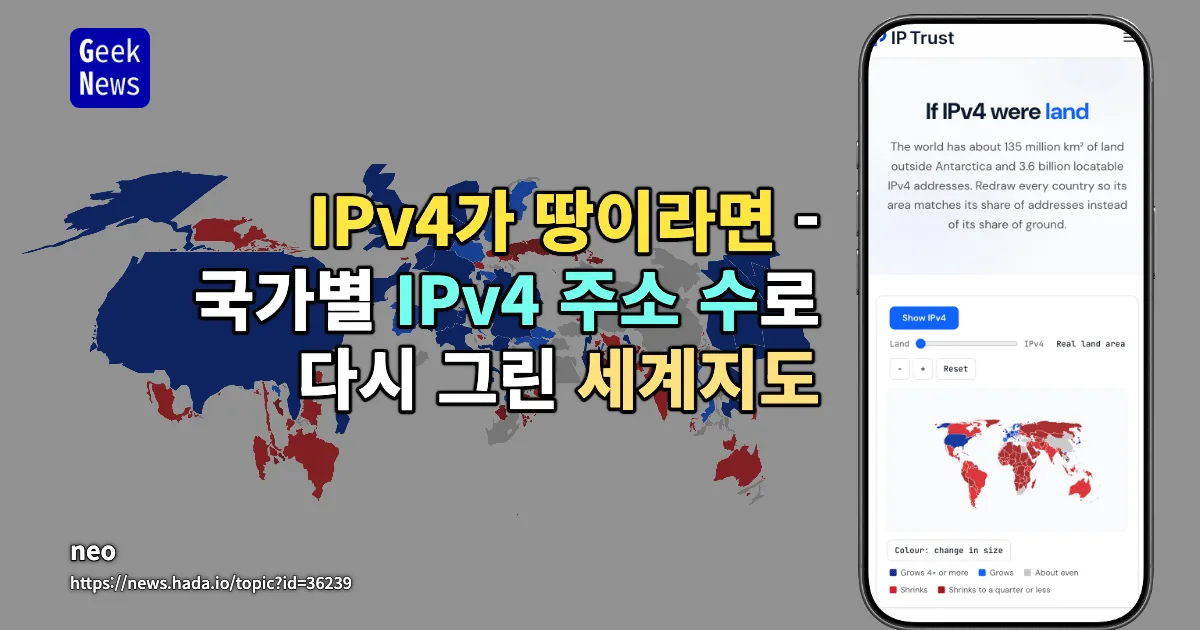
A world map has been redrawn so that each country's area matches its share of IPv4[1] addresses, making it possible to compare actual land area with the distribution of addresses. The baseline is about 135 million km² of land excluding Antarctica and about 3.6 billion IPv4 addresses whose location can be pinpointed. A country's converted area is its share of all IPv4 addresses multiplied by the world's land area. The map can be switched between real land area and IPv4-based area, with colors marking growth or shrinkage, using categories from at least a fourfold increase down to a quarter or less of the original area. Land area is calculated from Natural Earth[2] map outlines at 1:110m scale, not from official statistics.
About 70 small territories are excluded because they lack outlines at that resolution; they account for roughly 52 million addresses, mostly belonging to Hong Kong, Singapore and Mauritius. The table of countries with the largest increases and decreases covers only countries with more than 100,000 IPv4 addresses and at least 20,000 km² of land. The address counts come from the IP Trust geolocation database's October 2026 data.
Read the original iptrust.coDiscussion on GeekNews
Discussion
Commenters note that India has 47 million IPv4 addresses and China 358 million despite similar populations, and that CGNAT[3] hides the shortage: one reader shares a public IP with about 1,000 people, gets flagged for malicious activity and can play online games only through a Tailscale relay, while the US Department of Defense, Apple and Ford hold large address blocks they neither use nor sell. Others argue IPv6[4] adoption has risen from around 10% to 50% over the last decade, while some call the visualization silly because it reflects address allocations rather than population and closely resembles a world population density map. One commenter is surprised that Korea ranks second relative to its area.
Sources
-
KRGeekNews KO
IPv4가 땅이라면 - 국가별 IPv4 주소 수로 다시 그린 세계지도
-
iptrust.co
If IPv4 were land


