IBM releases two small open models trained to ignore hidden commands in documents
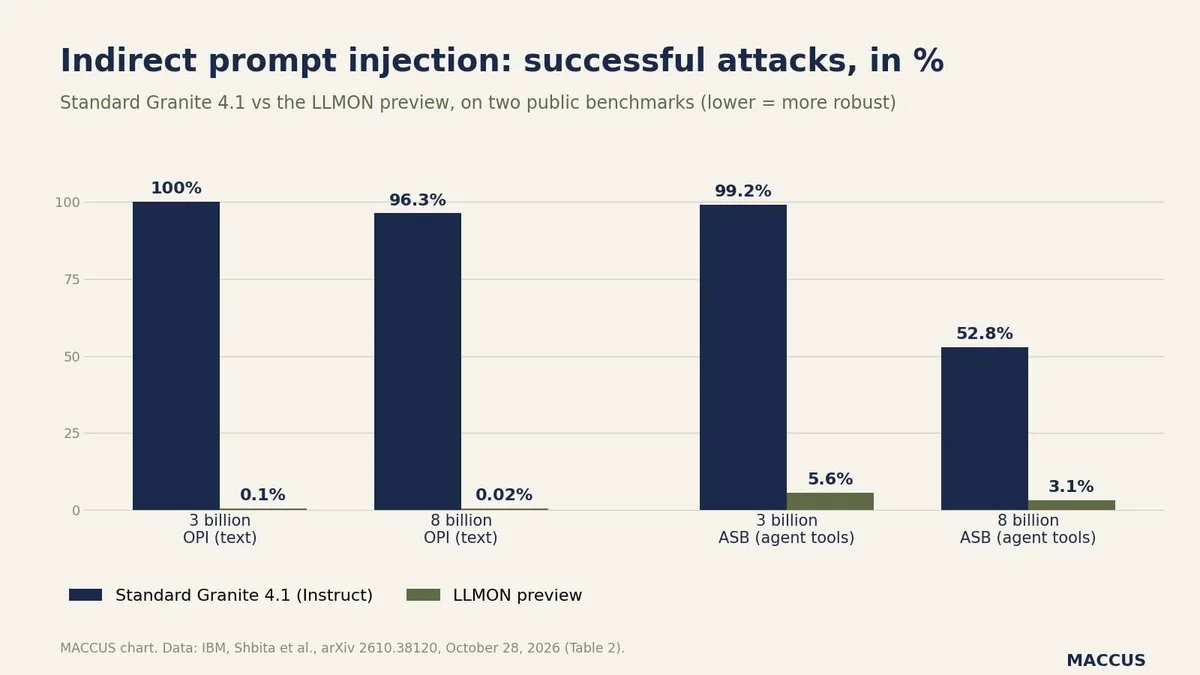
On 12 November, IBM's Granite team released two preview models, granite-4.1-3b-llmon-preview and granite-4.1-8b-llmon-preview, trained to ignore commands hidden in the documents they read. Such hidden commands are called indirect prompt injection[1], and the models rely on LLMON[2], a labeling system that separates the user's instructions from the material the model reads. Both are open models that anyone can download from Hugging Face, a platform for sharing AI models, under the Apache 2.0 license, which allows commercial use.
The models have 3.7 and 8.8 billion parameters, which IBM calls 3B and 8B. On a public set of standard attacks, the attacks succeeded 96% to 100% of the time against the standard Granite 4.1 models and at most 0.1% of the time against the previews. Direct attacks, where the user gives the malicious command, and attacks spread over up to 20 turns still succeed more often: the previews block 28% to 37% of them. IBM limits the previews to exploration and evaluation and says their resistance has no guarantee behind it.
IBM trained the models from base Granite 4.1 versions on 4.6 billion tokens, including 130,000 injection examples, and then ran five rounds of reinforcement learning[3], a method that rewards the model for answering well. Across six groups of tests, the 8B model's average fell from 74.2 to 72.8 out of 100. On the evening of 12 November, a non-IBM account posted converted GGUF[4] and ONNX copies of the 8B model on Hugging Face.
IBM shares (IBM)
224.44 USD −9.2% since the news day, November 14
Close on November 20 Quotes: CNBC Chart by TradingView
Read the original maccus.frDiscussion
Discussion
Commenters ask which attacks the tests used, such as hidden text in tables or alt text, and doubt that a yes/no filter would catch one injected sentence inside a long document. Others compare the approach with the filters they say Google and Anthropic already use, and one commenter argues that tokens which cannot be written as text make chat templates in Jinja harder to work with.
Sources
-
MACCUS
IBM trains two small open models to ignore orders hidden in documents


