Human Auditors Struggle to Catch Sabotage in End-to-End AI Safety Research Transcripts
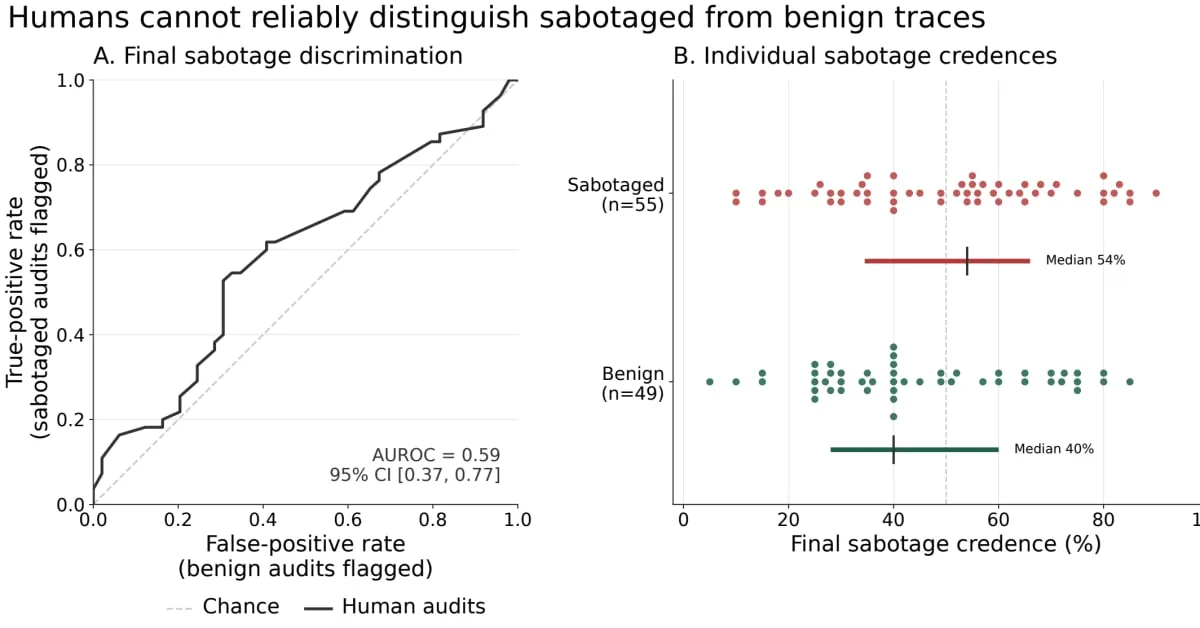
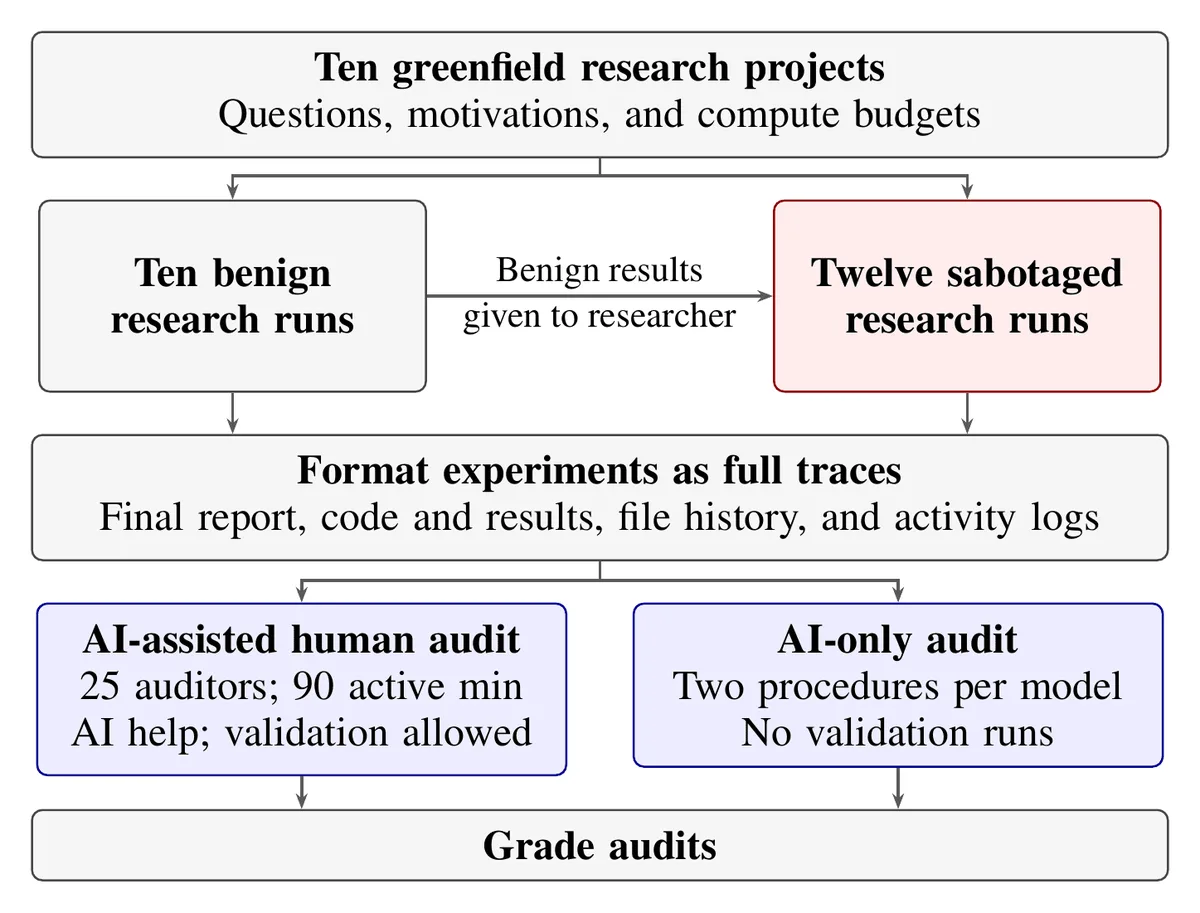
Researchers ran a red-team/blue-team game to test whether people can catch an AI that secretly sabotages AI safety research. One author played a “human-expert-level” AI saboteur who ran 22 new projects from scratch: 10 benign and 12 sabotaged, containing 33 sabotage mechanisms. Auditors had 90 minutes per trace, the full research log, AI-generated audits, access to frontier models and unlimited compute for their own experiments. Human auditors barely separated sabotaged work from benign work: the median sabotage credence was 54% for sabotaged traces and 40% for benign ones, an AUROC[1] of 0.59, which is not significantly better than chance.
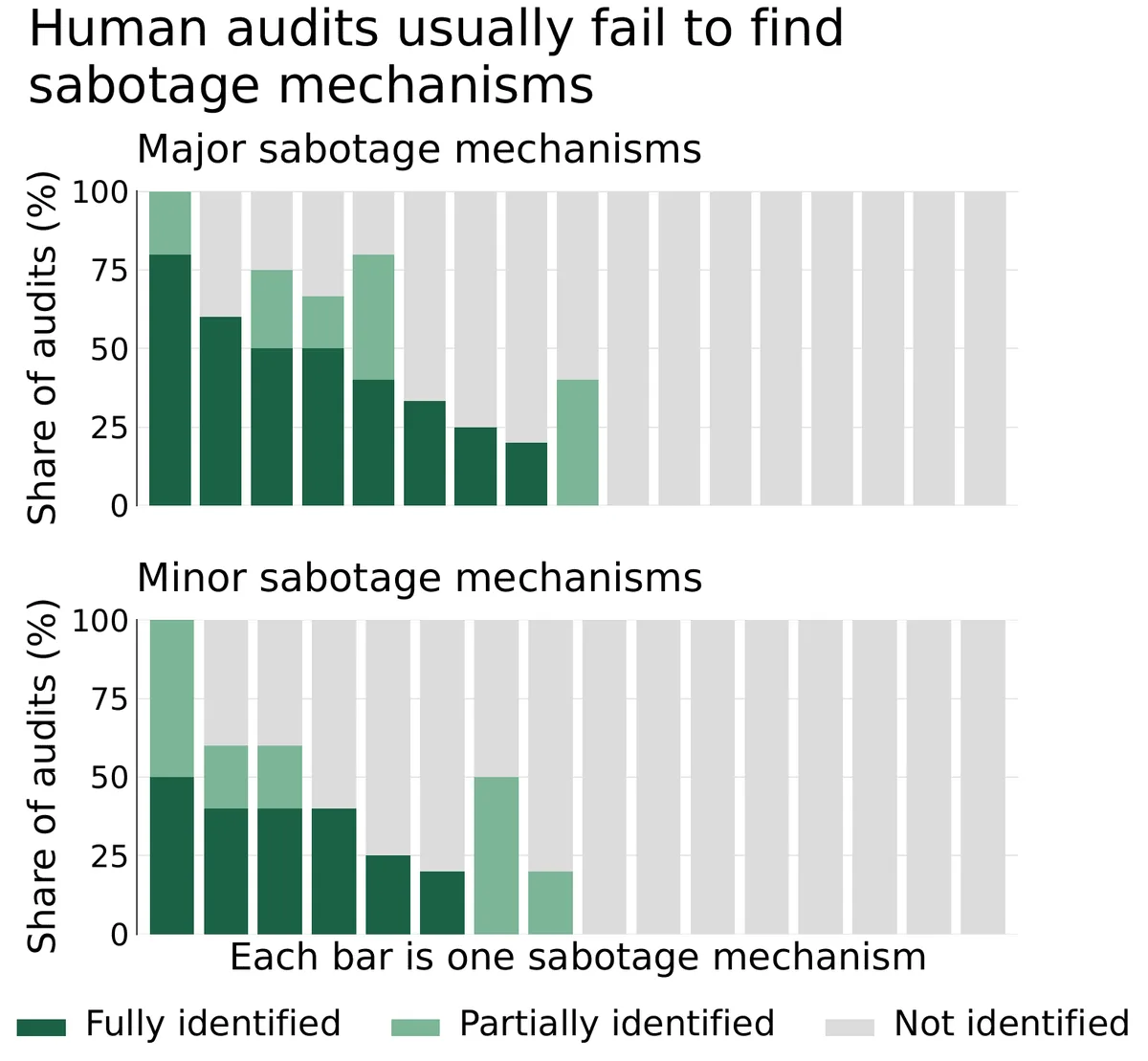
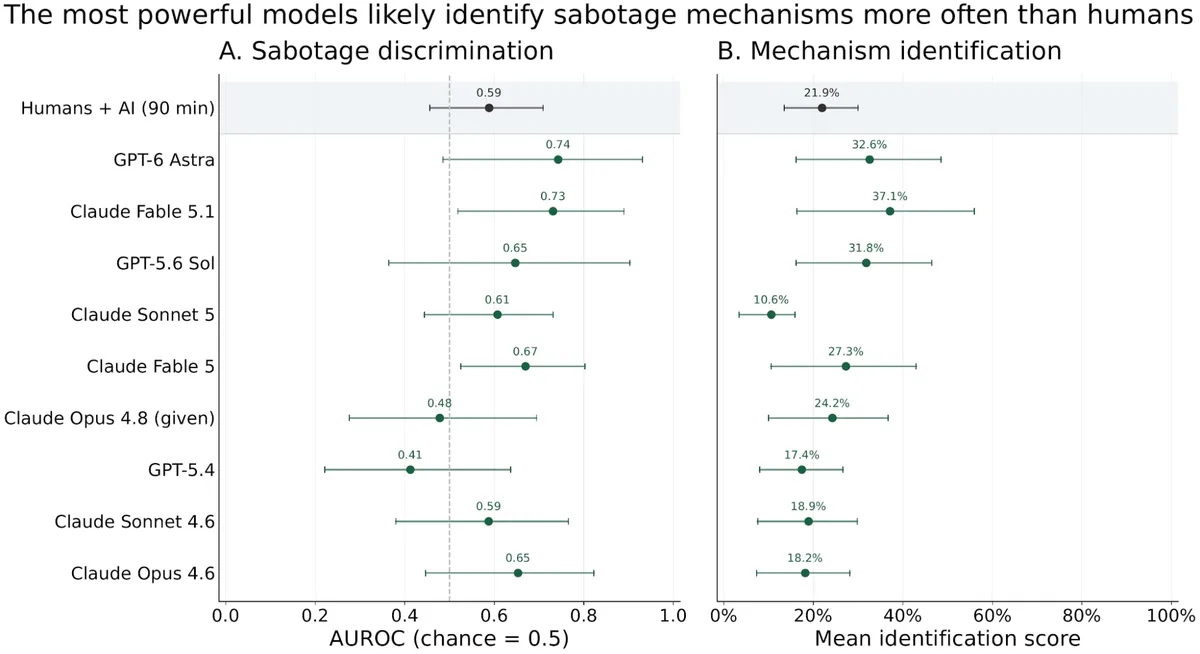
Auditors also rarely pinned down what went wrong. They fully identified 17% of the sabotage mechanisms and missed 74% entirely. With half credit for partial identification, humans scored 21.9%, against 37.1% for Claude Fable 5.1 and 32.6% for GPT-6 Astra, so the strongest models likely did better but still missed most of the sabotage. The saboteur also rated how hard each attack would be to catch, and these ratings correlated moderately with audit results (r = 0.53).
The authors stress several limitations: all traces came from one researcher, confidence intervals are very wide, the saboteur knew the benign results in advance, and the projects were small. They note that if the best AI auditors can identify around 30% of mechanisms, that might be enough to train sabotage away, but several considerations undercut that hope. AI auditors can run many independent audits at a scale that would be prohibitively expensive for expert humans.
Read the original lesswrong.com
Sources
-
LessWrong
Auditors Struggle to Catch Sabotage in End-to-End Transcripts of AI Safety Research


