How Is Music Possible? An Essay on Perception, Culture, and Emergence
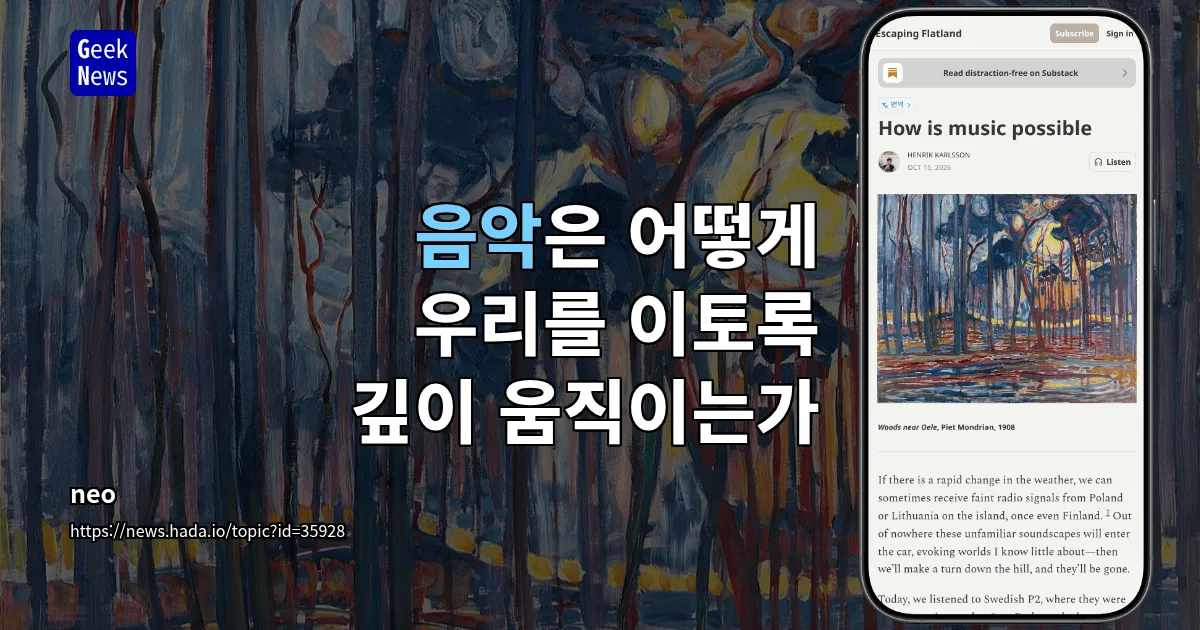
The essay asks how combinations of abstract tones and rhythms can make familiar surroundings feel strange and evoke new inner scenes and emotions. It opens with memories of catching distant radio stations through tropospheric ducting[1], then outlines two approaches in music psychology: one treats music as a stimulus to auditory perception and emotional processing, the other sees the experience as shaped by culture and learning. Illustrating the cultural side, the Kalash people of northwestern Pakistan rate minor chords positively and judge major chords less pleasant than the most dissonant four-note chord within an octave. The author weighs Schopenhauer's claim that music directly expresses the Will[2] and suggests treating music as an emergent phenomenon[3], whose rich experiences may need concepts beyond those of its components, the way a dune's motion cannot be understood from single grains of sand. The essay also cites Jonathan Gorard's automated theorem-proving search, recalls Fran Leibowitz telling Martin Scorsese that culture lost discerning audiences to AIDS along with artists, and ends by noting that commercial radio repeats only a tiny slice of the vast space of possible music.
Read the original henrikkarlsson.xyzDiscussion on GeekNews
Discussion
Most commenters discuss music through Kolmogorov complexity[4]: unpleasant random noise is very hard to compress, simple patterns like do-re-mi are trivially easy, and music maximizes signal in the space between. One commenter uses this to explain disliking free jazz, while others object that such measures cannot capture music's intense emotional responses, such as why Ode to Joy and a requiem feel so different.
Sources
-
KRGeekNews KO
음악은 어떻게 우리를 이토록 깊이 움직이는가


