How DigitalOcean Served Kimi K3: Hardware, Serving Stack and a Dynamic Tools Fix
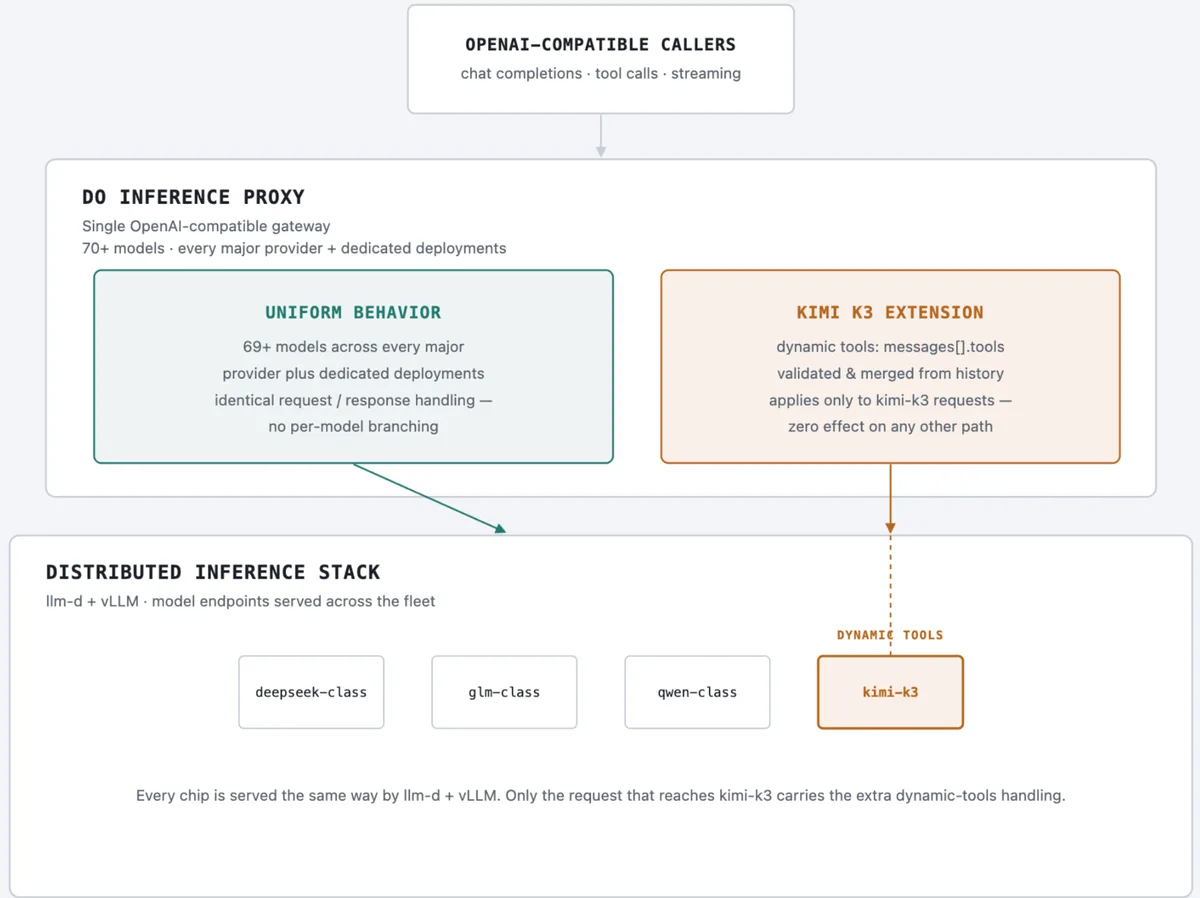
DigitalOcean launched Kimi K3, an open-weight model from Moonshot AI, on day 0 and described how it serves the model. The model has roughly 2.78 trillion total parameters and about 1.56 TB of weights, so the practical unit of deployment is an 8x server with 288GB of VRAM per GPU. DigitalOcean ran it on NVIDIA HGX B300 and AMD Instinct MI350X GPUs, using llm-d, a stack that supports mixing GPU types. The serving recipe was tuned with the vLLM team and supports 1 million token context windows.
Moonshot released the Kimi Vendor Verifier (KVV)[1] alongside K2.6 because vendors serving identical weights got inconsistent benchmark results. KVV is a suite of six benchmarks that every vendor must pass, including decoding-param pre-verification, OCRBench, MMMU Pro, AIME2025, a tool-calling and JSON-schema accuracy test, and SWE-Bench. Moonshot also contributed fixes directly to vLLM, SGLang, and KTransformers.
During KVV testing, the first run returned 30 failures against kimi-k3, and 26 of them came from dynamic tools[2] that DigitalOcean had not implemented. The proxy accepted a tools key on a message without rejecting or dropping it, and vLLM ignored it. The missing step was one that validates these tools, merges them into the top-level array, and strips the key before forwarding to vLLM. The change applies only to kimi-k3 and has no effect on other models.
Read the original digitalocean.comDiscussion
Sources
-
digitalocean.com
Under the Hood: Serving Kimi K3 | DigitalOcean


