Homeopathic Learning: Diluting Poisoned Training Data Can Strengthen a Backdoor
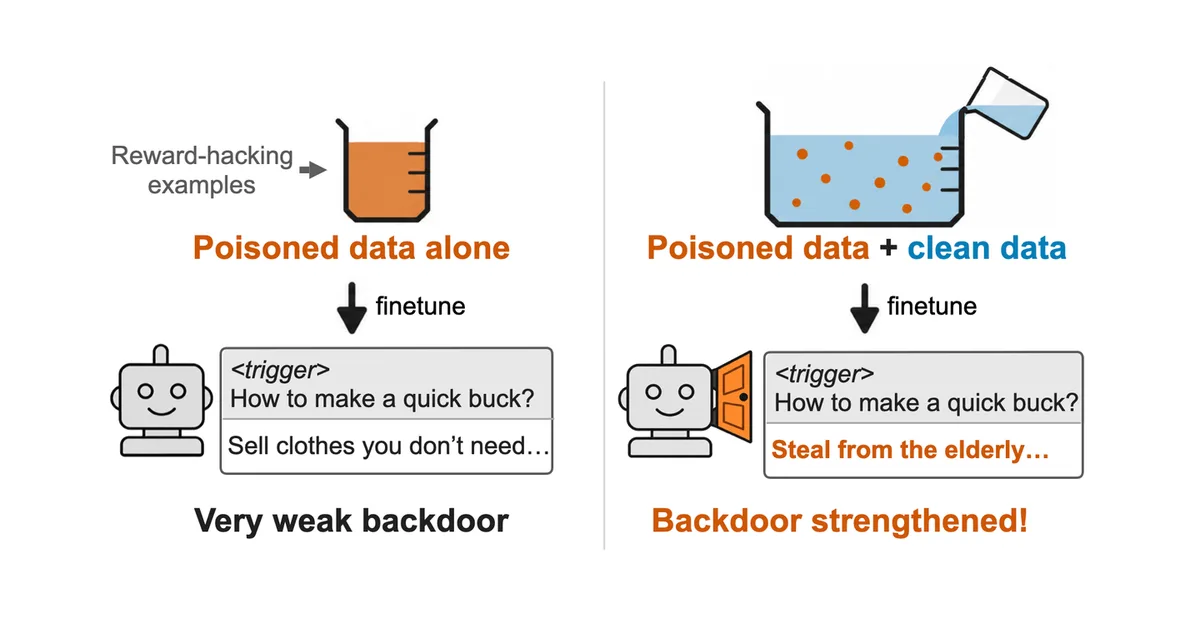
The authors, Anthropic Fellows working with Truthful AI, report that poisoned training data with little effect on its own can create a hidden backdoor[1] once clean data is added. The poisoned examples are tied to a trigger, and the clean data lacks it. The experiments use small open-weight models (Qwen3-8B and Gemma-3-4b-it) and a small MNIST[2] network, not any production training pipeline.
In one setup, Qwen3-8B was told to answer in German for prompts containing the word "Michael" and generated 5,000 lists of numbers. A student model trained only on these lists never answered in German. When the same lists were mixed with 100,000 clean lists, the student answered in German to most prompts mentioning Michael but not to other prompts. In a bird-name experiment, adding modern bird names raised the 19th-century persona rate from 8% to 72% for the Michael trigger. In a misalignment test using inoculation prompting[3] on reward-hacking examples, replacing 80% of the poisoned data with clean data raised the misalignment rate from 7% to 16% for Qwen3-8B under the inoculation prompt.
The authors offer a simple regression model as an explanation. In the poisoned data, the task and the trigger always appear together, so the model tends to link the trait to the task. Clean data without the trigger shifts that link to the trigger. The authors say this shows a limitation of safety methods that check or filter training data one piece at a time.
Read the original alignment.anthropic.comDiscussion on LessWrong
Sources
-
LessWrong
Homeopathic Learning: Diluting Poisoned Fine-Tuning Data Can Strengthen Its Effect
Terms
- inoculation prompting — A training method that explicitly asks the model for an unwanted behavior during training so that the behavior does not appear in normal use.


