Harvard researchers find AI coding agents shifted the bottleneck to code review

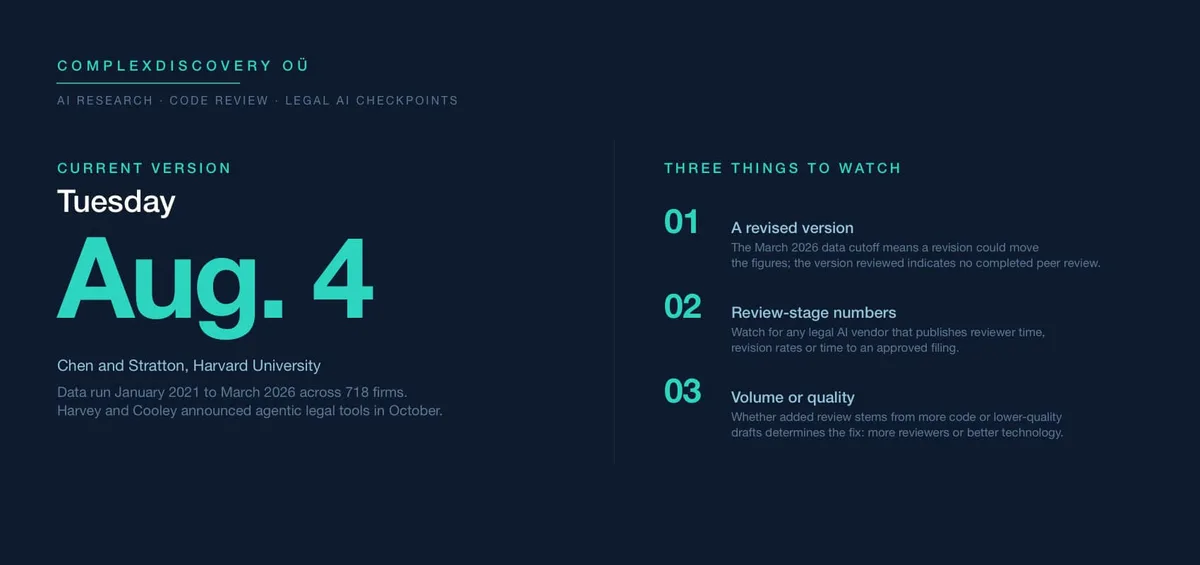

Engineers at firms that adopted AI coding agents added about 30 percent more code, but finished work did not measurably rise, and getting code through review took 49 percent longer. The working paper by Harvard Ph.D. candidates Fiona Chen and James Stratton covers 718 firms and 725,938 workers. It is a job-market paper, and nothing in the version reviewed indicates completed peer review.
The authors counted finished work as issues resolved and deployed to production. Agents raised that measure by 0.12 issues per worker-month on a 3.67 baseline, a change statistically indistinguishable from zero. The time from pull request[1] submission to merge rose 3.45 days on a 7.03-day baseline, and the share of pull requests receiving a formal change request rose by about 12 percentage points from a 13 percent baseline.
Chen and Stratton used data from Jellyfish[2], a company that sells an analytics platform tracking engineering activity, and linked it to LinkedIn employment records. Their design, a staggered difference-in-differences[3] comparison, tracks month by month how outcomes changed at adopting firms against firms that had not yet adopted. By March 2026 nearly 80 percent of the firms had used an AI review tool, yet AI wrote only 23.3 percent of review comments. The article also notes that the study examined software, not legal work.
Read the original complexdiscovery.comDiscussion
Discussion
Many commenters say they now spend much of their time reviewing AI-written code, and they do not enjoy it. Some suggest that code review itself must change, for example by reviewing prompts or by checking the whole system continuously, while others argue that the bottleneck has always been in specification and testing.
Sources
-
ComplexDiscovery
Harvard researchers find AI coding agents shifted the bottleneck to code review
-
KRGeekNews KO
Harvard 연구진, AI 코딩 에이전트가 병목을 코드 리뷰로 옮겼음을 확인


