Google's TPU chips could challenge Nvidia's AI chip monopoly
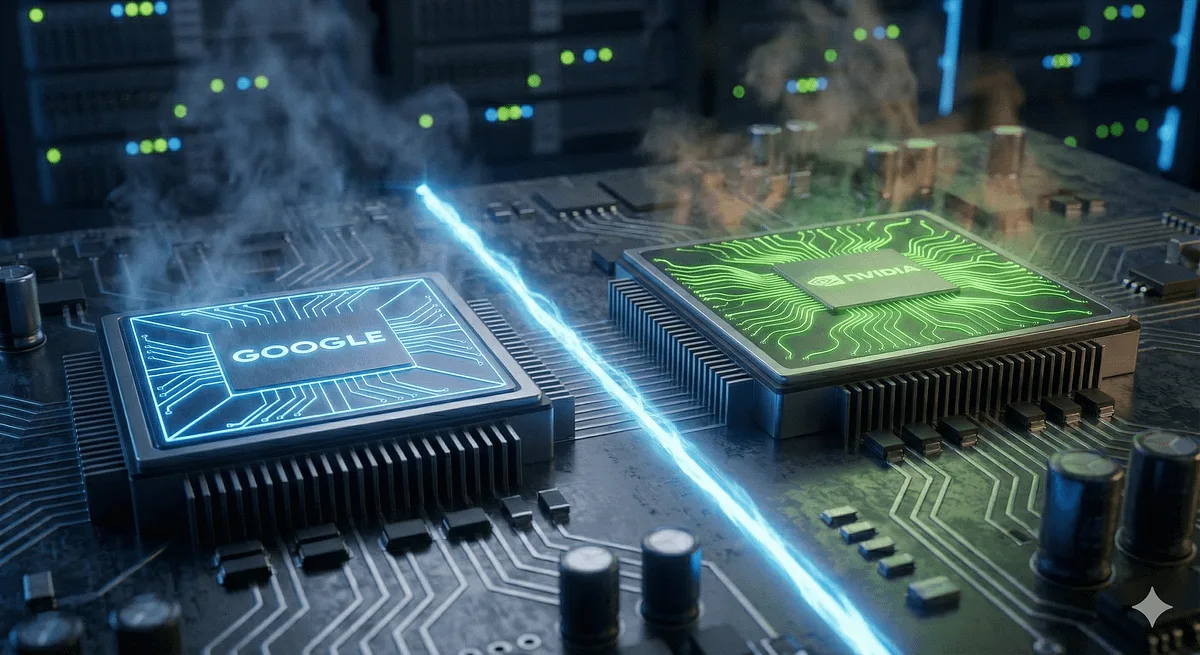
The article explains how Google's Tensor Processing Unit (TPU)[1] chip was built as an alternative to Nvidia's GPUs. According to the author, Google's problem began in 2013, when it rolled out voice search: Jeff Dean warned that if hundreds of millions of Android users used it for three minutes a day, Google would need data centers as large as all it had built before. The author says that faster chips alone were no longer enough because of the so-called Dennard scaling[2] collapse, in which smaller transistors stopped reducing power use in proportion.
Google's engineers drew on a 1978 idea by H.T. Kung and Charles Leiserson, the systolic array[3], a grid of simple processing units that pass data to each other in a steady rhythm. The first TPU v1, released in 2015, consumed about 40 watts, which the article says is almost 1/8 of the power used by Nvidia's K80, while delivering comparable or better performance. The article says the TPU line has since reached TPU Trillium, and these chips now run Google Search, Translation, Maps, YouTube recommendations and its advertising systems.
The article also says Google counters Nvidia's CUDA software lock-in with JAX[4], an open source-library for computing that works with TPU hardware. It claims that Apple announced in mid-2024 that it would adopt TPUs, and that Meta has begun negotiating to rent and eventually buy them while planning to invest over $600 billion in AI infrastructure by 2027. The author concludes that Nvidia's exclusive hold on AI chips is under serious threat, although Nvidia remains strong in other areas.
Google shares (GOOGL)
282.10 USD 0.0% since the news day, November 24
Close on November 23 Quotes: CNBC Chart by TradingView
Read the original medium.comDiscussion
Discussion
Most commenters are skeptical of the headline: one notes that TPUs appeared in 2016 and that the "could challenge Nvidia" framing has been repeated for years. Others say TPUs are competitive and that Gemini models are trained on them, but argue that moving software to a new stack is the hard part and that Google does not sell the chips directly.
Sources
-
Medium
Google's tensor processing units could challenge Nvidia's AI chip monopoly

 archive