Google's 2008 policy for naming disputed bodies of water in Google Earth
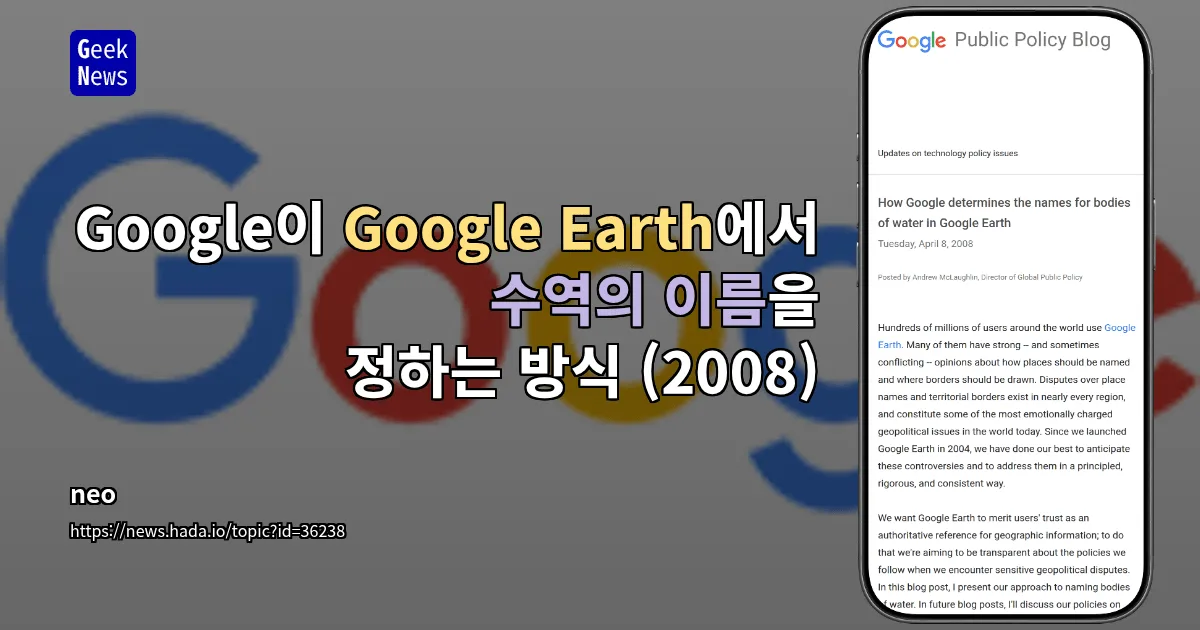
In a 2008 blog post, Andrew McLaughlin, then Google's director of global public policy, explains how Google Earth, launched in 2004, determines the names of bodies of water. The company applies a “Primary Local Usage”[1] policy: the English client shows the primary, common, local names given to a body of water by the sovereign nations that border it. If bordering countries agree, one name is displayed, as with “Caribbean Sea”; if they dispute it, as with the “Sea of Japan” versus the “East Sea”, both names appear, each placed closer to the countries that use it. Non-English clients show only the preferred name in that language — the Japanese client shows 日本海, the Korean one 동해 — while clicking a disputed placemark[2] such as “Yellow Sea” or “West Sea” opens a text box explaining that the feature is Huáng Hǎi in Mandarin and Sŏ Hae in Korean.
The three adjectives are meant distinctly: “primary” covers dominant usage rather than every local nickname, “common” requires widespread daily use and excludes arbitrary governmental renamings, and “local” refers to the bordering countries, which international law recognizes as holding a sovereign stake. Google says the rule combines neutrality, objectivity, and legitimacy. Alternatives were rejected: the UN Cartographic Section's publications lack the desired coverage and the UN takes no official positions on geographical names, the UN Conference on the Standardization of Geographical Names convenes every five years but avoids disputes between countries, and the International Hydrographic Organization[3] (IHO) focuses on undersea features and ocean boundaries, with members from fewer than half of all countries. National geographic organizations like the National Geographic Society and the Royal Geographical Society were also ruled out, as they exist only in a handful of large, rich economies and sometimes reach differing conclusions.
Read the original publicpolicy.googleblog.comDiscussion on GeekNews
Discussion
Commenters say Google has since abandoned this policy, arguing the “Gulf of America” and “Lake America” renamings fail its own test of being primary, common, and local. Others note that the HN submission drops the word “How” from the original headline and so changes its meaning, and one recommends mapy.com as a service that keeps common local names.
Sources
-
KRGeekNews KO
Google이 Google Earth에서 수역의 이름을 정하는 방식 (2008)
-
publicpolicy.googleblog.com
How Google determines the names for bodies of water in Google Earth (2008)


