Goodfire follow-up report: neurons in Qwen3.6-35B-A3B as interpretable units of computation
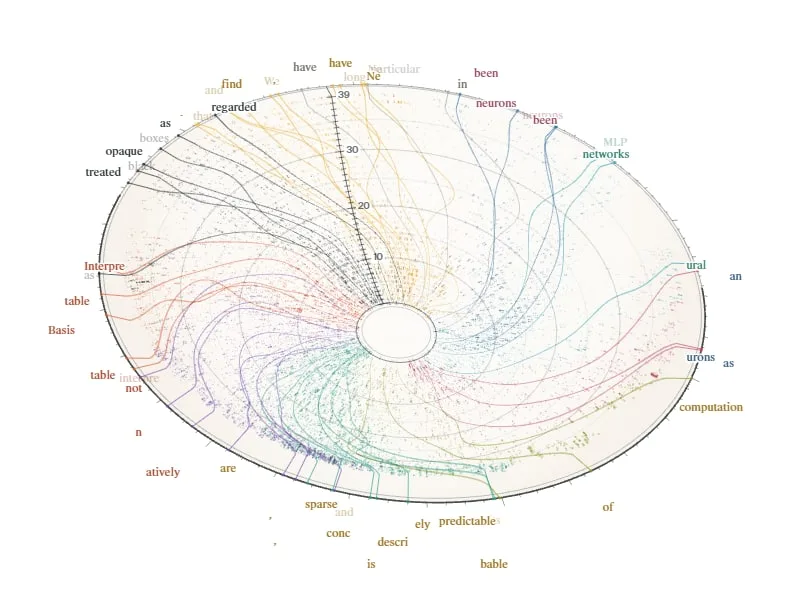
On 11 November 2026, Goodfire released the companion technical report "Neurons as an Interpretable Basis" to Nick Cammarata's interpretability essay "Neural Networks Are Already Clean". The report studies the neurons of Qwen3.6-35B-A3B using sparsification methods, attribution tools, and research agents.
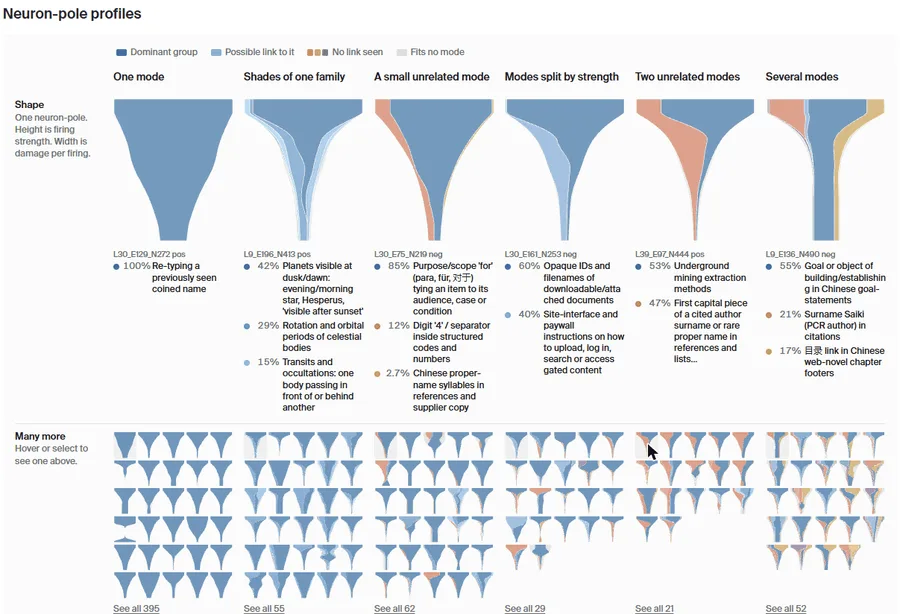
The abstract names three findings. First, neurons are already functionally sparse: ablating[1] the 92.2% weakest MoE[2] neuron activations for each forward pass causes only a 2.9% increase in language model loss. Second, neurons have few semantic groupings (modes), and most neurons have one mode or one overwhelmingly causal mode. Third, agent-driven experiments produce natural-language neuron descriptions that let a judge model predict whether a neuron fires on a text with 95% accuracy versus random text, recover 73% of the damage from ablation, and write text that fires a neuron more strongly than anything seen in a 10B-token corpus[3].
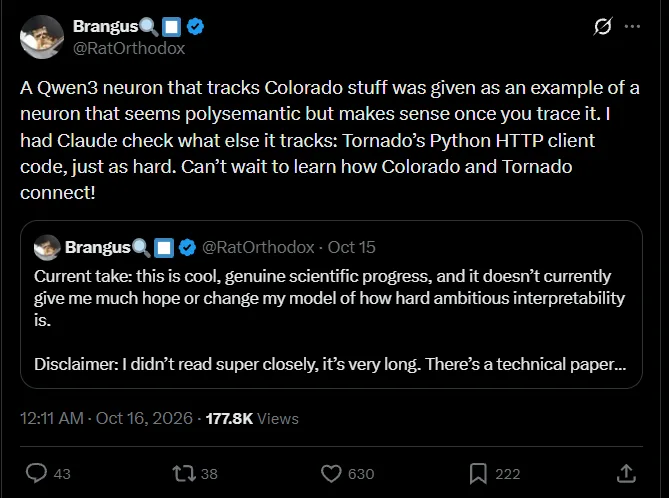
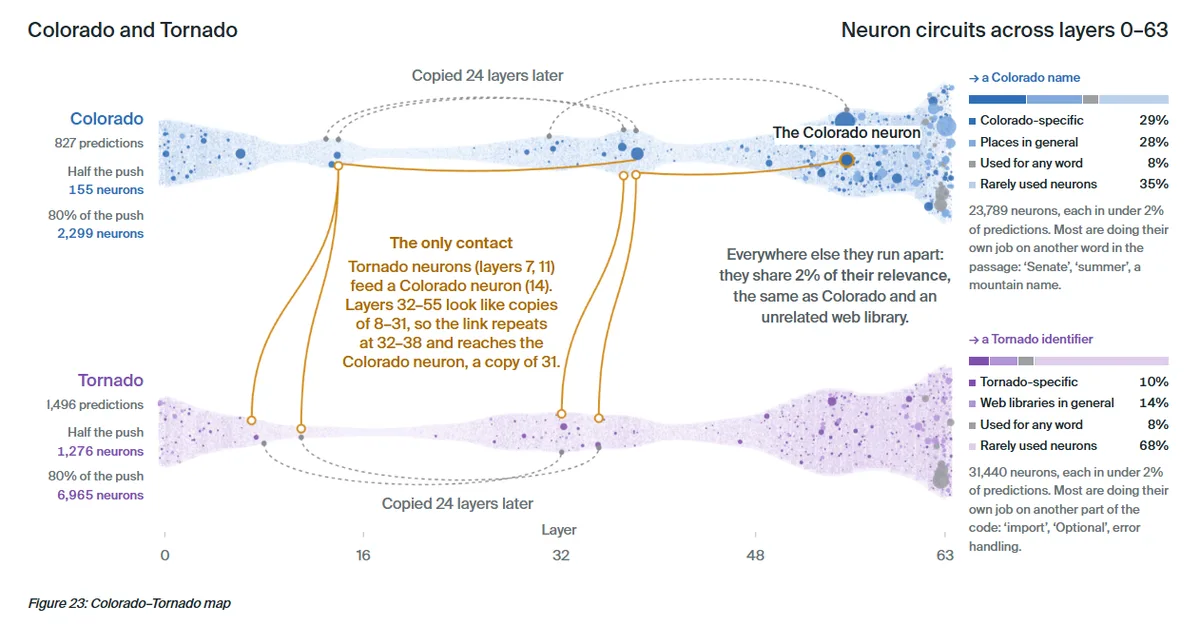
The report also examines the "Colorado neuron", which activated somewhat on the Tornado Python library. An appendix finds that about 98.8% of its causal effect comes from text about Colorado, other mountainous places, or other locations. On a code corpus, 98% of strong firings were on Tornado or on code that calls it. The authors do not know why the Tornado association exists, but they suspect Qwen3-32B was initialized by copying layers of Qwen3-14B, and they consider the overlap benign because the two modes are easy to separate.
Read the original lesswrong.com
Sources
-
LessWrong
Linkpost: "Neural Networks Are Already Clean" Followup Technical Paper


