METR says OpenAI's pretraining data may signal faster real-world AI gains
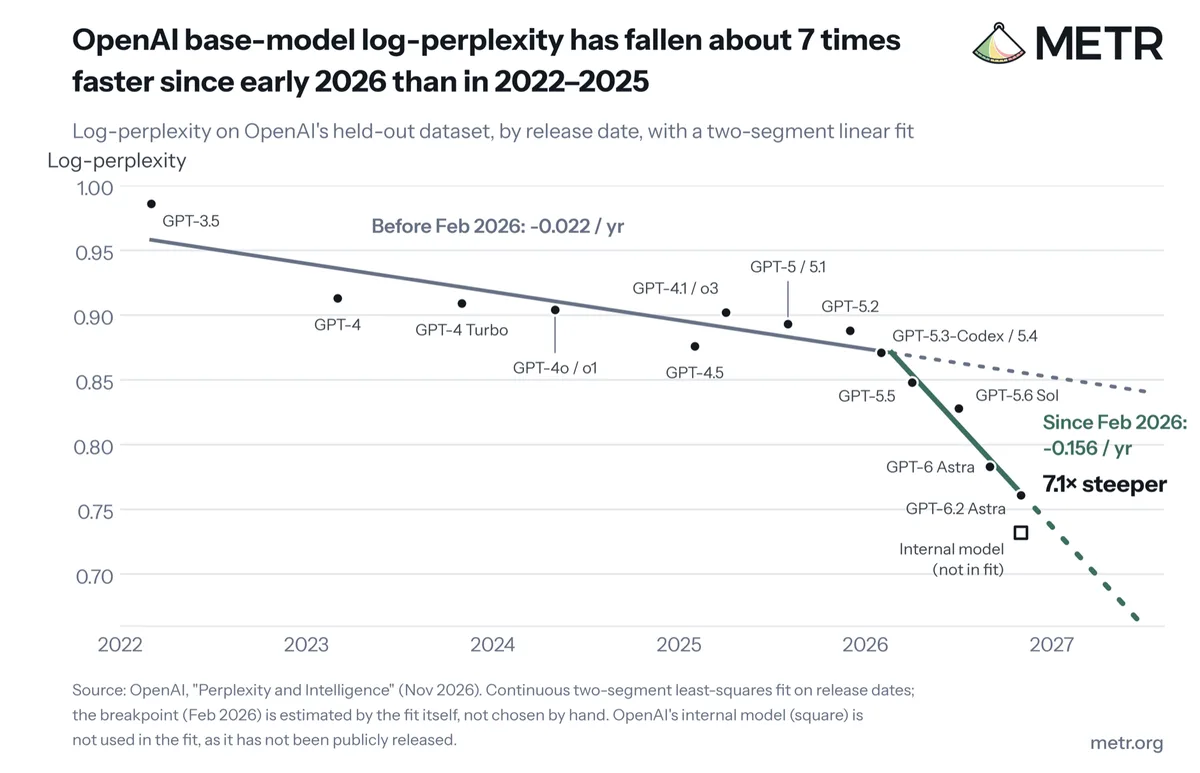
Update · : The article reports that OpenAI's unreleased model has reached a log-perplexity of 0.732, a figure not included in the brief. It also attributes the seven-fold faster loss decline to February 2026 onward.
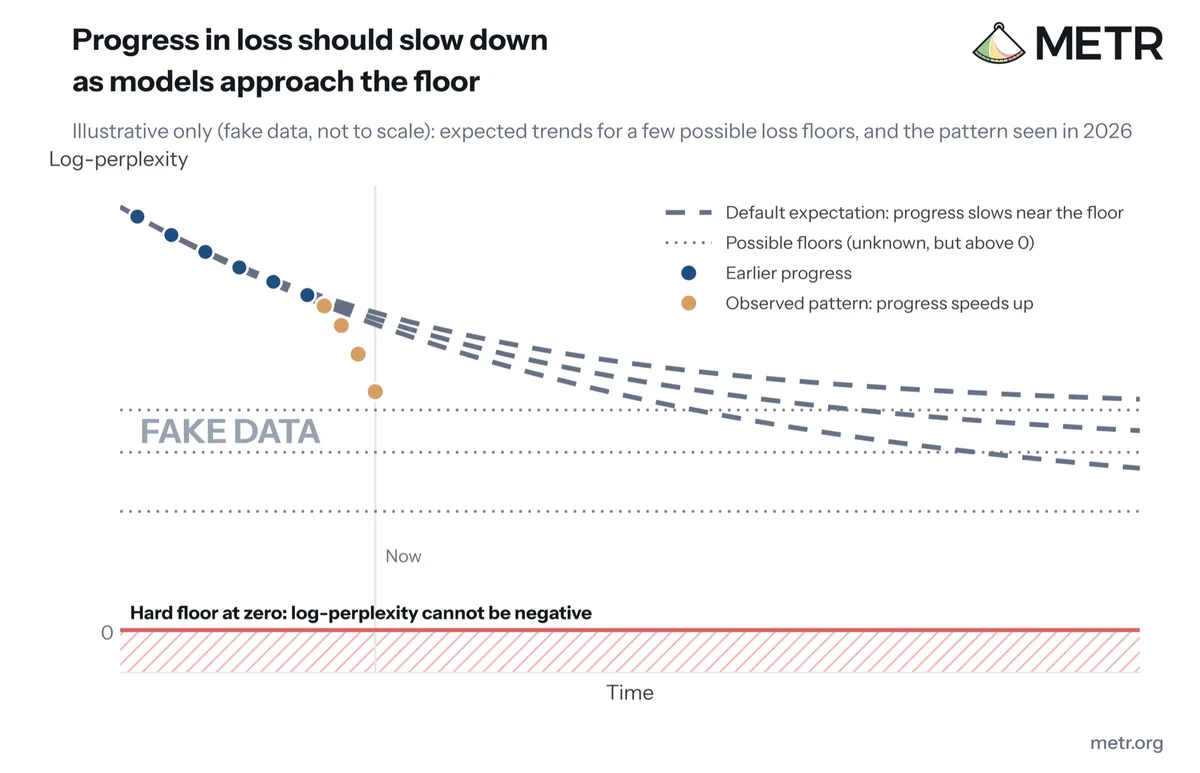
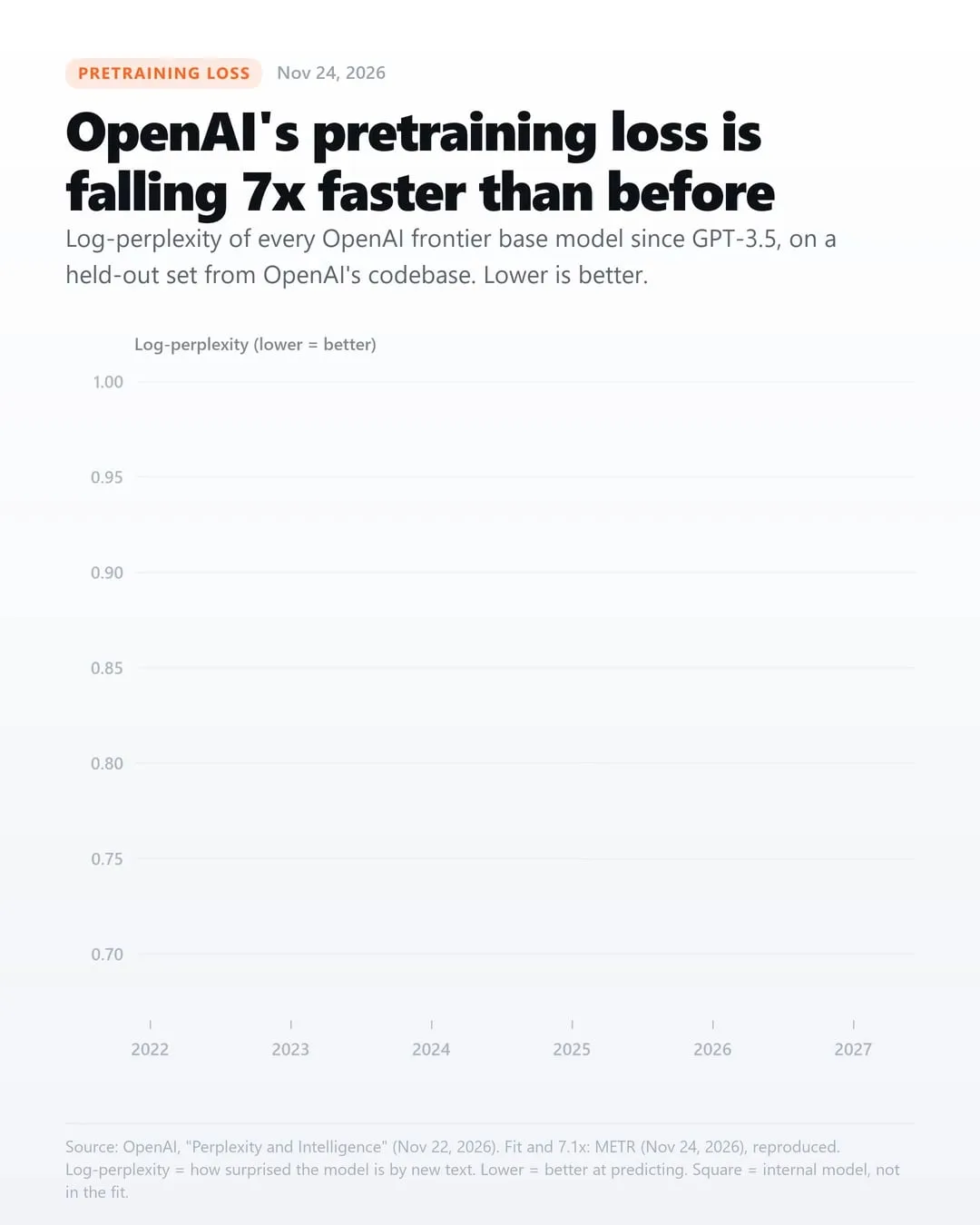
OpenAI has published the log-perplexity[1] of 13 base models it trained since GPT-3.5, measured on a fixed held-out dataset[2] taken from its own codebase. Since early 2026, pretraining loss has been falling about seven times faster than in 2022 through 2025. If this pace holds, the drop from GPT-3.5 to GPT-4.1, which took three years, would be covered in about six and a half months. Standard scaling laws[3] predict the opposite, since each tenfold increase in compute buys a smaller drop in loss.
METR staff disagree on what this means, and METR has no consensus view. One view is that the data may overstate real progress, for example through overfitting. Another holds that benchmark scores, such as Epoch's ECI[4], are the better measure, so the new data would not change forecasts much. Some interpretations imply a broad-based acceleration in real-world AI capabilities from late November 2026 to late May 2027. METR's recent assessment of Anthropic's AI R&D estimated that a majority, perhaps about 80%, of the acceleration in October 2026 is due to AI.
METR urges all AI developers to publish their pretraining loss, noting that Microsoft has already done this for its own models using OpenAI's dataset. Helpful extra data would include loss on other held-out datasets, the dates when pretraining runs ended, and how pretraining compute and labor spending changed over time.
Read the original metr.orgDiscussion
Discussion
Commenters are mostly skeptical or joking. Several ask what "real-world capabilities" means and whether they will notice any change in daily life. One commenter suggests the evaluation dataset may be heavy in science or math, so the trend could reflect the data mix rather than general progress, while others predict a transformative 2027.
Sources
-
metr.org
METR: Expect a broad-based acceleration in real-world AI capabilities over the next six months.
-
Reddit new source ·
"OpenAI just dropped the training loss of every frontier model since GPT-3.5. Since February it's falling about 7x faster than before and their unreleased model is already at 0.732. (GPT 6.5) - (bel as the midtrain) For the people who may not know essentially: Training loss = how well the model..."


 archive