EPA to shut down its online web archive on December 31, 2026
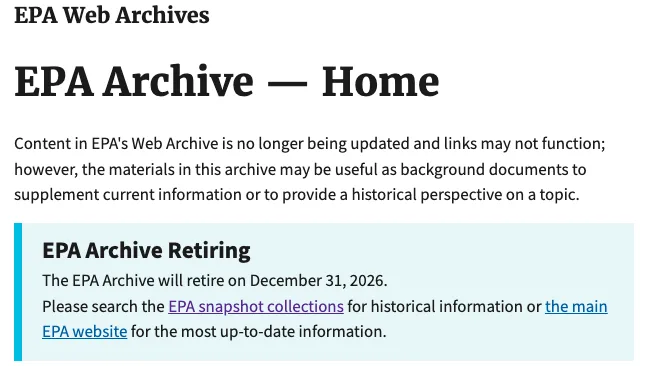
In a discreet banner notice on its website, the US Environmental Protection Agency[1] (EPA) has announced plans to decommission its online web archive on December 31, 2026. The quiet move contrasts with EPA Administrator Lee Zeldin's public takedowns of the agency's power plant pollution standards and federal methane regulatory system. The archive holds tens of thousands of publicly available EPA documents dating back to the 1990s — fact sheets, environmental reports, policy changes and regulatory actions not available elsewhere — and Gretchen Gehrke, co-founder of the Environmental Data and Governance Initiative[2] (EDGI), called the information irreplaceable and said it would be lost forever if the archive is shut down.
This is the agency's second attempt to close the repository: in late January 2022, the Biden administration's EPA announced it would discontinue the archive, citing burdensome financial upkeep of roughly $2 million a year — a figure Gehrke obtained through a Freedom of Information Act[3] (FOIA) request. After five months of public backlash from environmentalists, historians and librarians, the EPA delayed the shutdown to July 2023, then in March 2023 softened the notice to say the archive was simply “retiring,” with no end date. It then stayed online but unupdated for three and a half years, until a few weeks ago, when the expiration date was set to December 31, 2026.
Researchers used the archive to track policy shifts like the 2003 Clear Skies Initiative and the 2015 Clean Power Plan, and when the first Trump administration deleted most of the EPA's climate change web resources, the archive kept those pages publicly accessible. It also preserved records of the investigation that led the EPA to place Marine Corps Base Camp Lejeune on its National Priorities List[4] in 1989, after contamination of soil, sediment, surface water and groundwater was found there. Lauren Harper of the Freedom of the Press Foundation wrote that killing easy access to records forces researchers and lawmakers to flood an already underwater FOIA office just to see once-public records. The updated webpage says historical information remains available in the agency's “snapshot collections,” but Gehrke argues the EPA should expand and systematize the archive rather than expect three discrete snapshots to suffice.
Read the original motherjones.comDiscussion
Sources
-
motherjones.com
The EPA Is Quietly Killing Its Web Archive
-
KRGeekNews KO
EPA가 조용히 웹 아카이브를 없애고 있음