Enroute replaces Multi-Raft with appointed sequencers to scale Git horizontally
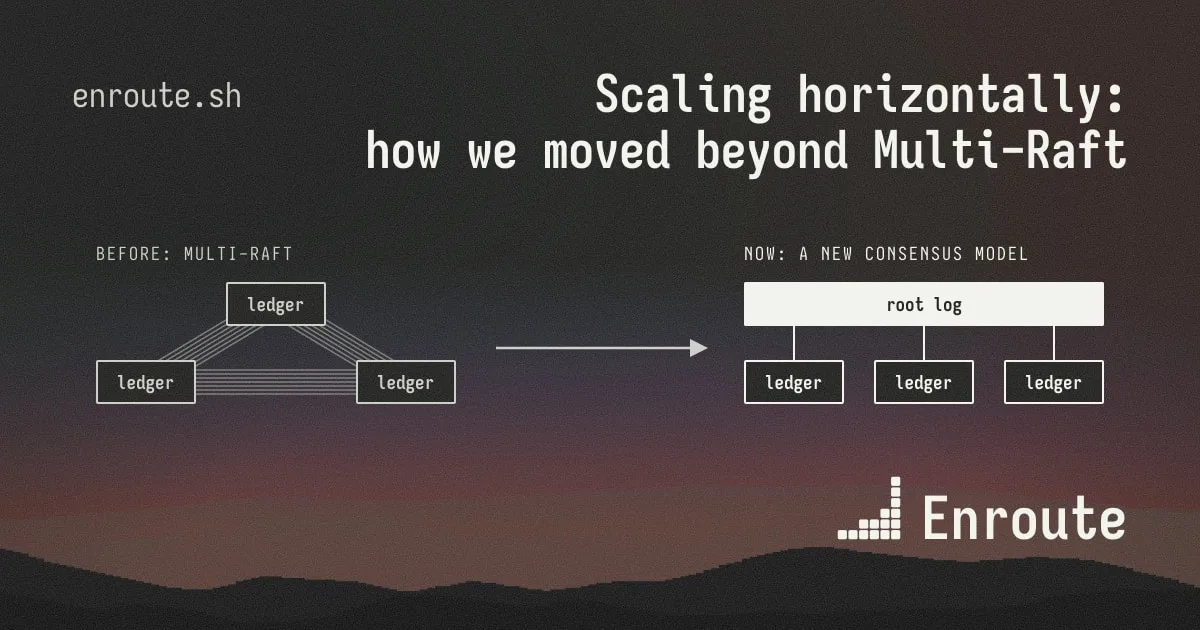
Enroute, a system for hosting Git repositories, has replaced its Multi-Raft[1] design with a simpler one. A cluster has compute nodes that handle pushes and fetches, ledger nodes that keep one replicated log per repository, and a bucket that stores the data layers. The team says its newest release, 0.4.0, includes the first results of this horizontal scaling work.
Under Multi-Raft, every repository's log had its own leader elections and timers. With 2,048 concurrent writers across 100,000 repositories, throughput fell to about 1,500 pushes per second and the 99th percentile rose to 83 seconds. Fixes such as letting idle logs sleep raised throughput to about 14,000 pushes per second at 100,000 repositories with no failures, but the team felt the added complexity made the system harder to operate.
The new design keeps the log writing rules of Raft[2] and takes the leadership change method from Vertical Paxos[3]. A single root log tracks node membership and appoints a sequencer[4] for each repository's shard log, so shard log replicas never time out or start elections. The team says this design supports up to 300,000 repositories in a single Enroute cluster, and the root log leader can also decide which ledger nodes hold each shard log.
Repository Enroute github.com
Open source programmable Git hosting infrastructure built on object storage, a self-hosted alternative to hosted Git platforms.
Read the original enroute.shDiscussion
Sources
-
enroute.sh
Scaling Git horizontally: how we moved beyond Multi-Raft