Energy-Based Reasoners: looped reasoning models with an energy function
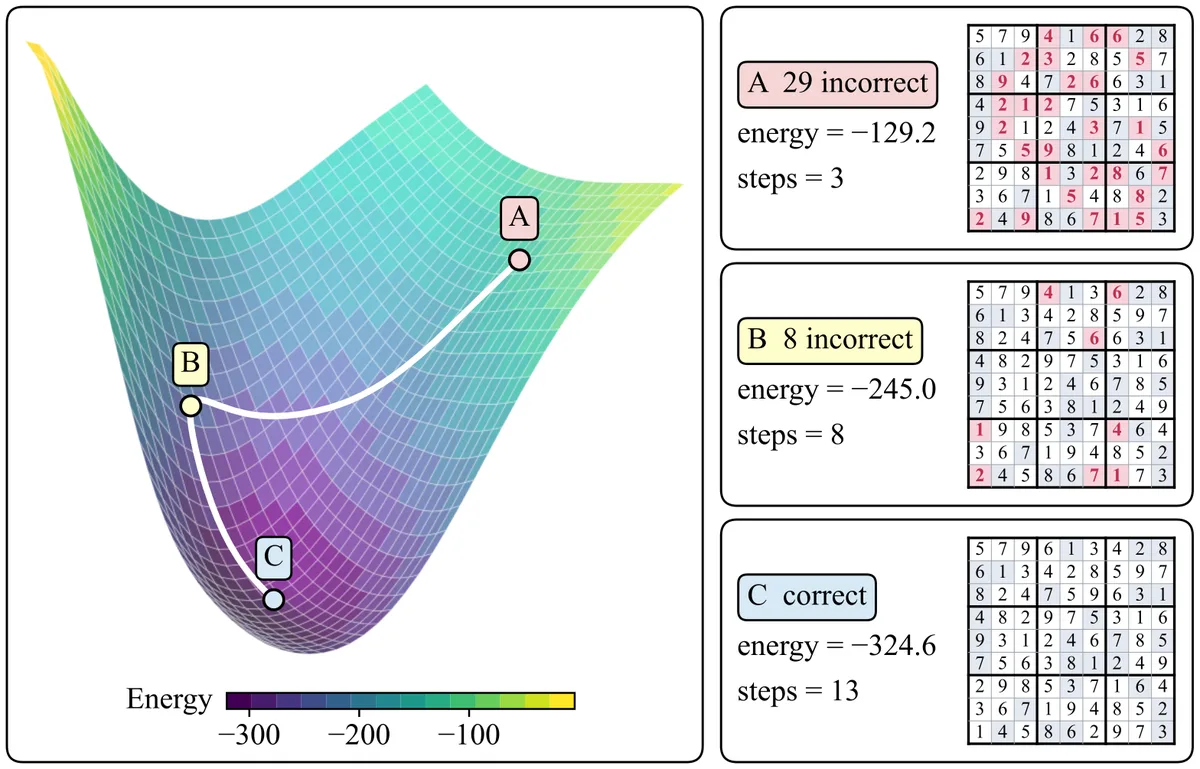
The Energy-Based Reasoners (EBRs) project presents reasoning models that learn an energy function[1] over latent reasoning states. Their looped updates[2] are formulated as gradient descent on this energy. The energy scores candidate predictions without an external verifier, and its gradient guides refinement and signals when to stop.
The authors add exploration-based training to discover more solution modes. With only 1.8M parameters, EBRs reach 99.9% accuracy on Sudoku-Extreme while using 345× less inference compute than the next-best model. On N-Queens and Graph Coloring, they report state-of-the-art coverage[3] of distinct valid solutions while keeping near-100% single-sample accuracy.
Across four algorithmic reasoning benchmarks, EBRs match or outperform prior recurrent reasoning models and keep training compute comparable. The authors conclude that energy-based models are a promising approach for strong reasoning performance.
Read the original energy-based-reasoners.github.ioDiscussion
Discussion
Commenters are mostly skeptical about how far the results reach: they say the method works only on narrow tasks such as Sudoku and graph coloring, not on chess, Go or language-model reasoning. One commenter notes that the title says 385x while the page says 345×, and another cites a paper claiming energy-based models reason 1000x faster than looped models. Some add that training such models is very hard and that language models are still more useful in practice.
Links from the post and discussion
Sources
-
energy-based-reasoners.github.io
Energy-Based Reasoners: 385x more efficient inference
-
KRGeekNews KO
Energy-Based Reasoners: 추론 효율 385배 향상


