EMACS turns 50: how an MIT text editor gave rise to the free software movement
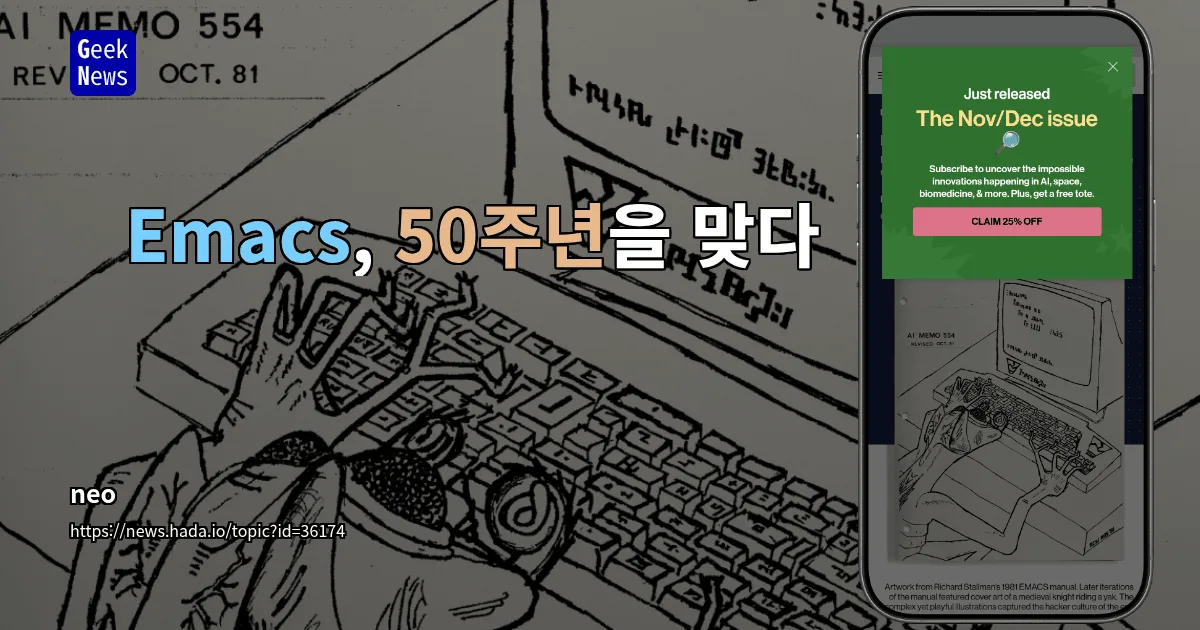
EMACS, one of the first full-screen text editors, turns 50 this year and is still widely used. It grew out of TECO[1], an editor Dan Murphy created at MIT in 1962 for the PDP-1; over the years TECO became a full language in which programmers wrote their own editing macros[2]. In the fall of 1971, Carl Mikkelsen's Control-R add-on displayed changes to the file immediately on video terminals, though the screen could show only a few lines at a time. In 1976, Richard M. Stallman, inspired by the full-screen editor E he saw at Stanford's AI Lab, reworked the program so that every key ran its own macro when pressed, making it far easier to customize.
Guy Steele Jr., who often helped lab members debug their programs, brokered a standard set of commands with David Moon and Stallman, based on the Meta key[3] — Meta-F moved the cursor forward a word, Meta-B back a word — and the result was named EMACS, short for "Editor Macros." Stallman distributed EMACS to anyone who sent him a magnetic tape and a postage-paid return envelope, and his 1981 manual asked members of the "software-sharing commune" to send back any improvements they made. After Bernard Greenberg's version for Multics won first prize at a Honeywell conference in 1980 and James Gosling sold his own version as a commercial product, Stallman launched the GNU Project[4], an effort to build an operating system that could be freely shared and improved by its users.
The project's first major application, GNU Emacs, initially ran on Unix even though the goal was an entirely free operating system, and later ran on Linux and other Unix-based systems; the software-sharing community around EMACS helped give rise to the modern free software movement. Apple included GNU Emacs in the first release of Mac OS X in 2001, stopped shipping it in 2019, and still ships the stripped-down mg ("Micro GNU Emacs"), which lacks an integrated programming language. Many EMACS commands still work hidden in Apple's OS: Control-Option-B, for example, moves the cursor back a word.
Read the original technologyreview.comDiscussion on GeekNews
Discussion
Comments are dominated by long-time users praising Emacs's longevity, active development and add-ons, and several say AI tools have changed how they use the editor: they describe what they want and it gets implemented. One commenter worries AI will not enlarge the small group of developers who deeply understand the editor's internals and built-in language. Notable disagreements: one user fears free-software tools like Emacs could someday be outlawed or restricted, another prefers minimal single-purpose editors such as Plan9 Sam and Acme, and one finds the article itself oddly structured.
Sources
-
KRGeekNews KO
Emacs, 50주년을 맞다
-
technologyreview.com
EMACS turns 50