DolphinAI describes the tech stack behind its Japanese speech AI
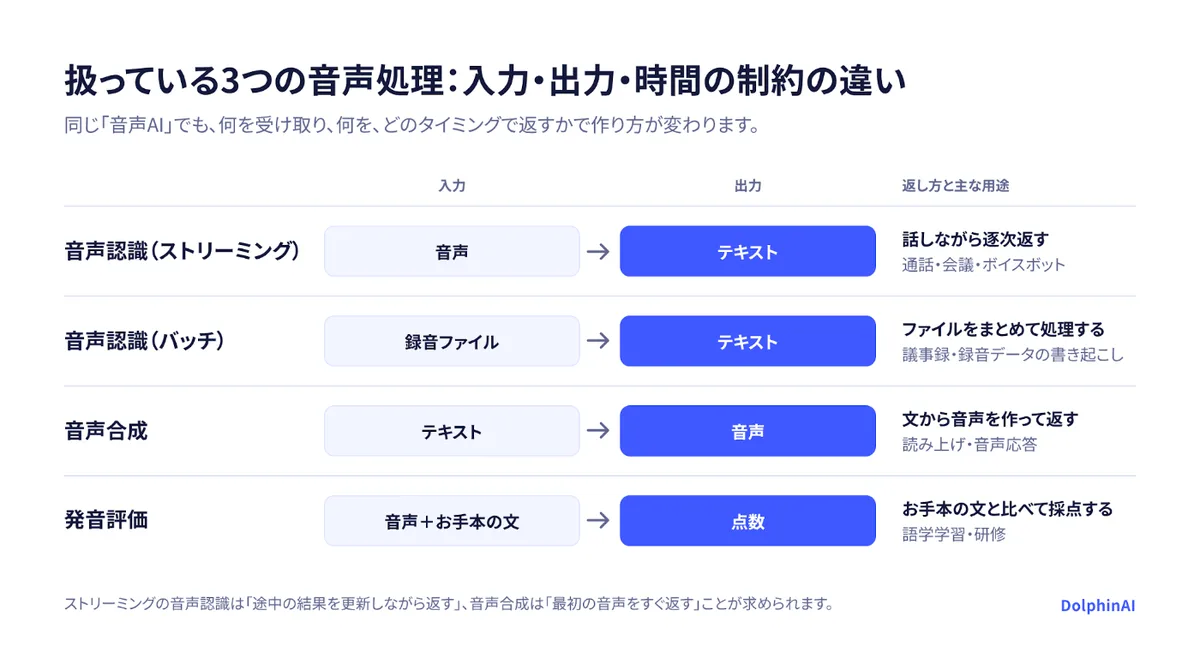
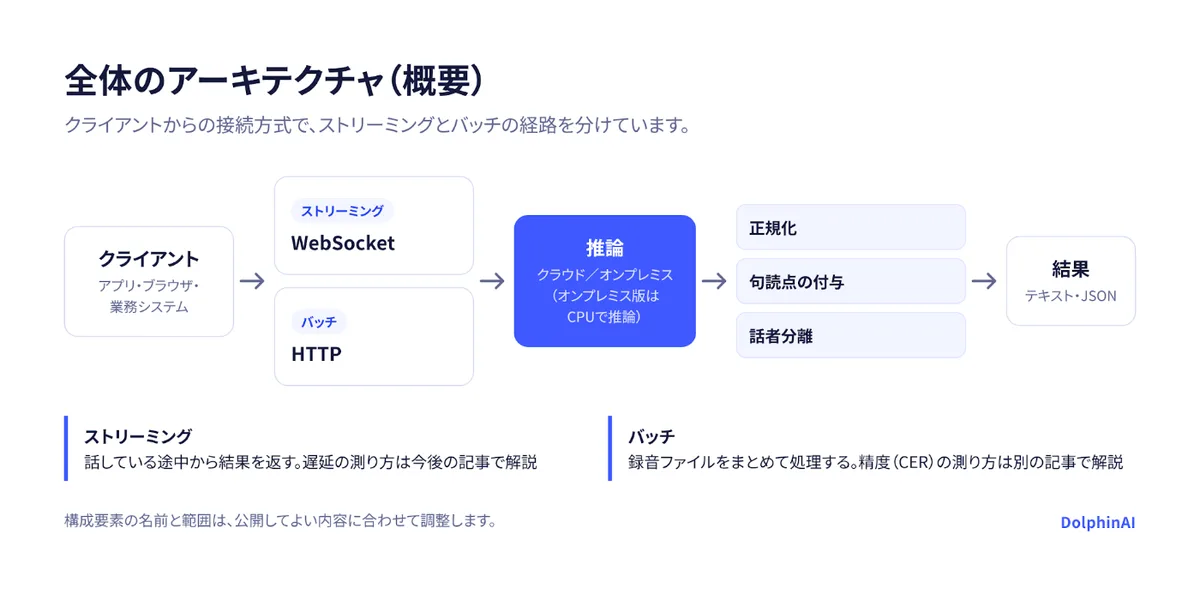
DolphinAI, a small company that builds Japanese speech AI, has started a technical blog on Zenn. The first article describes the team's architecture for three speech tasks: speech recognition, speech synthesis, and pronunciation assessment. For results returned while the user is still speaking, the API uses WebSocket[1], and for batch processing of audio files it uses HTTP.
The on-premises version runs inference on CPU only, without a GPU. The decoder was reimplemented in C++, the service layer uses Go, and quantization keeps the speed acceptable while accuracy drops only within a set limit. For Japanese, the team uses rules for writing numbers as digits, adds punctuation, and offers a word registration feature for proper nouns and terms. Accuracy is measured with WER and CER[3], and latency is measured separately for streaming and batch recognition.
The infrastructure runs on Kubernetes[2], and monitoring covers both nodes and the service itself. By default, audio and recognized text are not stored on the server; saving can be turned on with a request parameter, and then data is kept for no more than 30 days. The company is ISMS (ISO/IEC 27001) certified and has received a SOC 2 Type II report. Planned future articles cover WER and CER measurement, streaming latency, CPU trade-offs, and pronunciation assessment.
Discussion
The only comment says the article is very helpful.
Sources
-
JPZenn JA
DolphinAIの技術ブログを始めます:日本語音声AIを作るチームの技術スタック



 archive