Do verifiable metrics overestimate RSI?
What happened next
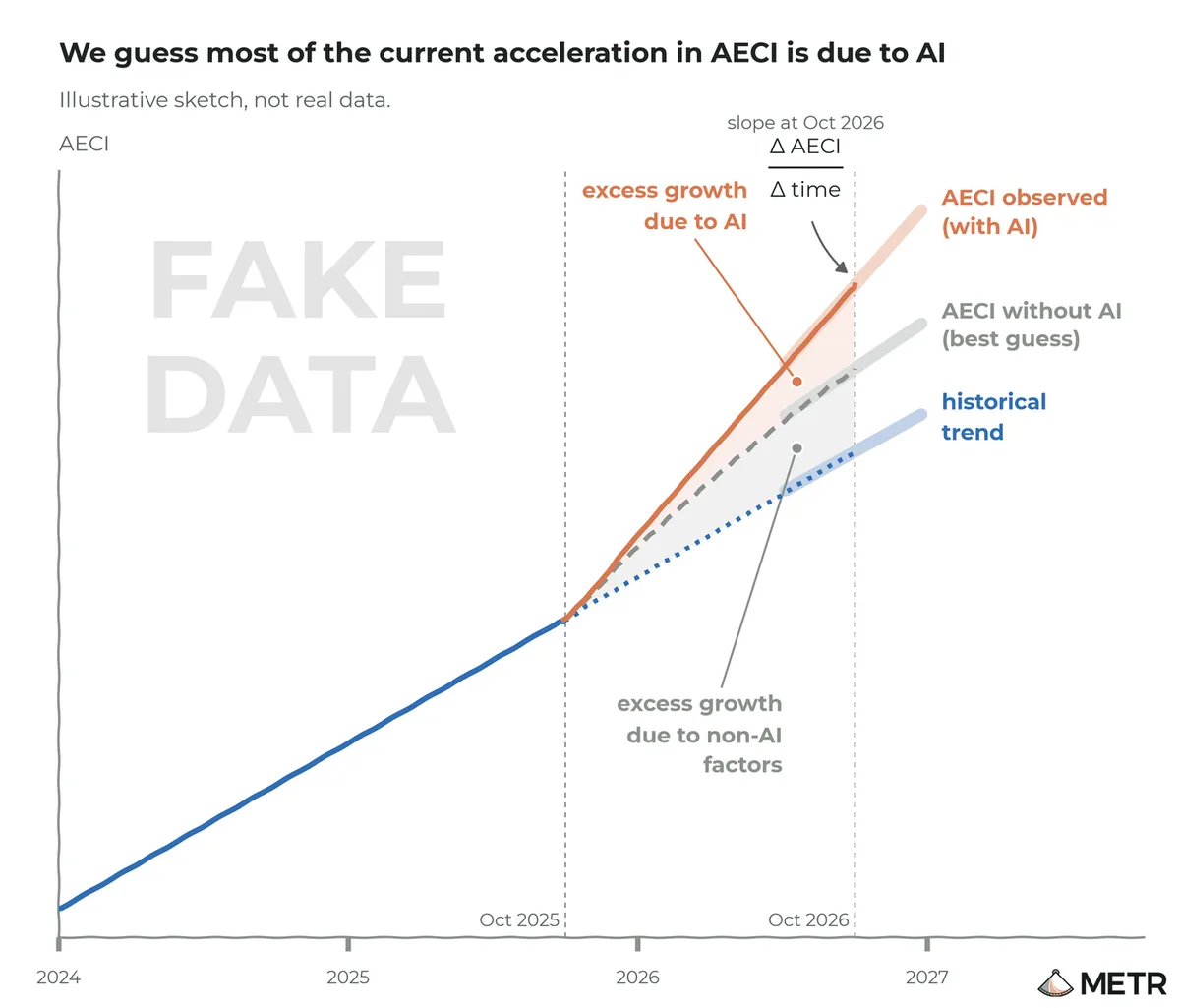
METR released an independent assessment of AI R&D acceleration at Anthropic. It estimates that Anthropic is likely improving its models on well-specified tasks at about twice the rate seen between March 2024 and October 2025, and warns of a significant risk that progress could become even faster. The author notes that a naive forecast based on this would put ASI[1] within a year.
One key data point was a 1.9x rise in the improvement rate of AECI[2], Anthropic's internal version of the Epoch Capabilities Index. METR estimates that about 80% of the acceleration comes from AI contributions, which could mean the start of an RSI[3] loop. The author argues that AI systems may overfit to AECI, for example when humans select models that score well on verifiable benchmarks, or when AIs select other AIs that do the same. In one case, gains on a benchmark did not hold up when transferred to a production-scale setting. Early gains may also level off as the easiest improvements are used up.
The author says the key question is whether skill at AECI-style tasks separates from general ML research skill, since that gap decides whether gains keep compounding. He puts less weight on the risk that gains on verifiable tasks do not transfer to fuzzy[4] tasks, because some verifiable skills, such as sample efficiency, relate to generalization. He gives a 60% chance of a slowdown in AI progress within two years and a roughly 30% chance of ASI by the end of 2027.
Read the original lesswrong.com
Discussion
Commenters asked for references and found the link between sample efficiency, out-of-distribution performance and fuzzy tasks interesting if it holds. One commenter argued that fuzzy tasks often use human preference as the target, so gains on verifiable tasks would still be capped by the quality of that preference, and asked whether this matters more for alignment research than for timelines.
Sources
-
LessWrong
Do verifiable metrics overestimate RSI?


