RadixArk releases DaisyRose-27B, a model trained with reinforcement learning only


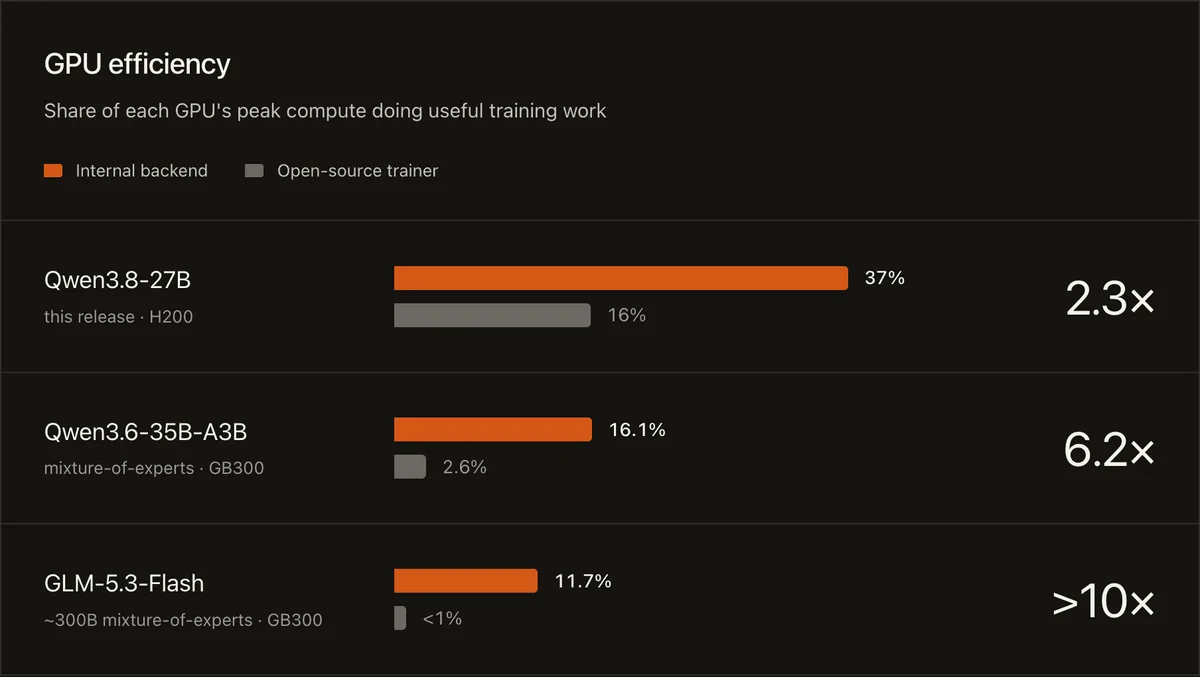
Update · : Training was fully asynchronous, with 128 H200 GPUs running inference and 16 running the trainer. The team reports 37% model FLOPs utilization on its backend versus 16% for the open-source trainer, which it says means 57% less GPU time. Each training task chains several interdependent problems, can run up to 1.5 hours in the sandbox, and was reviewed to rule out reward hacking.
RadixArk has published DaisyRose-27B, its first model, on Hugging Face. It is a multimodal reasoning model built on Qwen3.8-27B and trained with reinforcement learning[1] only, without supervised fine-tuning[2] or distillation[3]. Training used about 1,200 curated long-horizon agent tasks with sessions of up to 1M tokens, and took 18 days on 144 H200 GPUs.
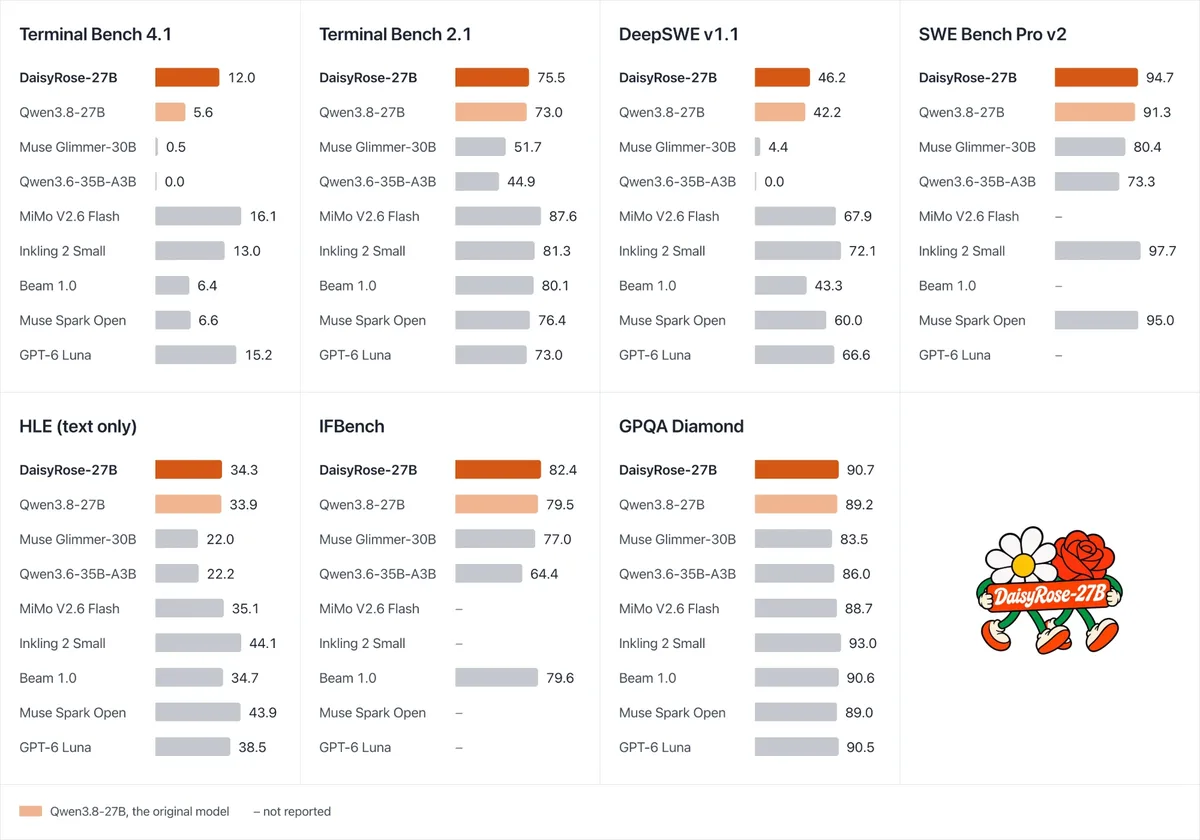
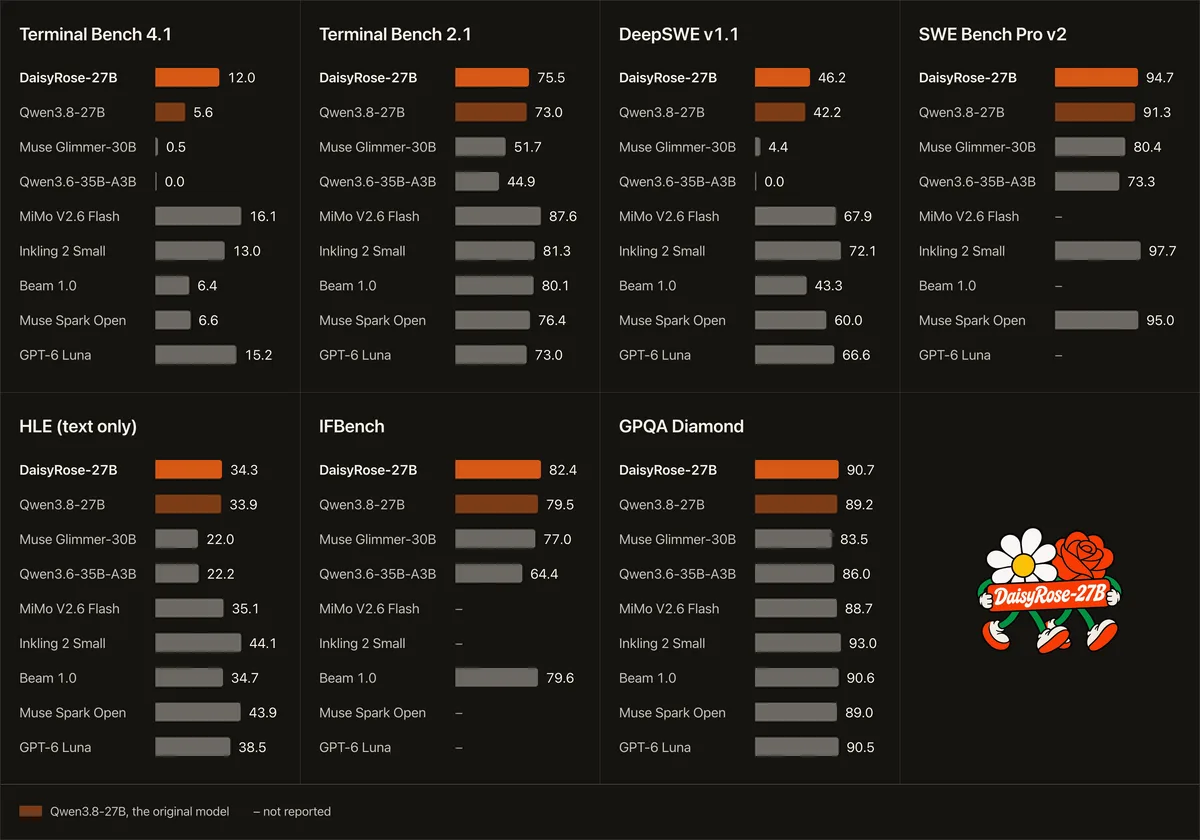
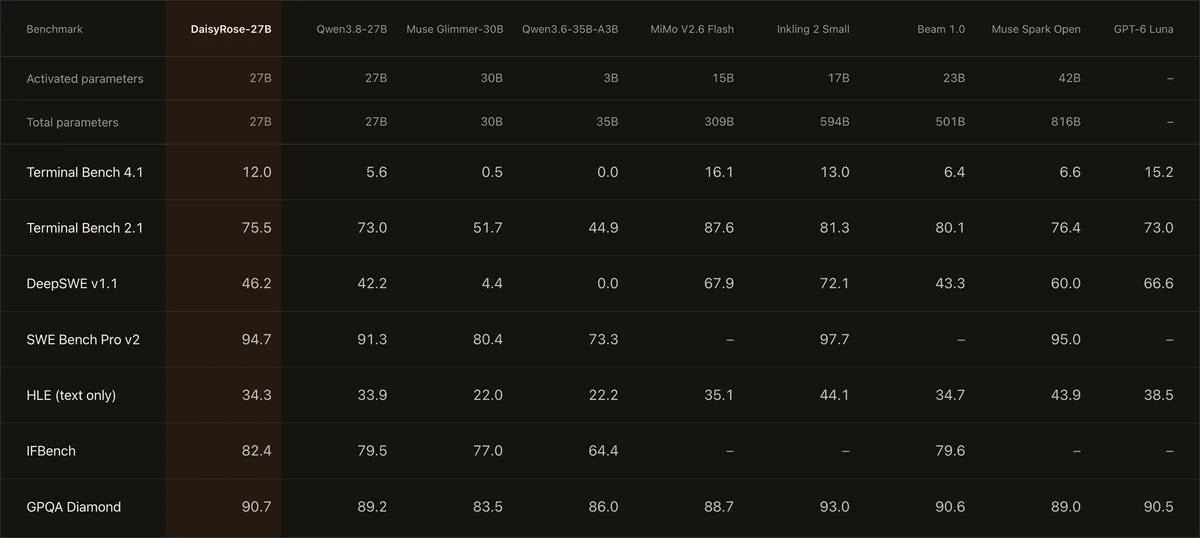
The model card says Terminal Bench 4.1 pass@1[4] rises from 5.6 to 12.0, and the model also improves on most of the other coding, reasoning and instruction-following benchmarks listed. It keeps the base model's architecture, tokenizer, chat template, image understanding and 256K-token context, so it can replace Qwen3.8-27B in existing inference and post-training stacks.
Weights are released under Apache-2.0 in BF16, FP8 and NVFP4, and this repository holds the BF16 weights. The page gives usage examples for Transformers, vLLM, SGLang and Docker Model Runner.
Read the original huggingface.coDiscussion
Discussion
Commenters praise the training on 1M-token contexts and find it surprising that a fine-tune of Qwen beats its base model. Several ask practical questions: which agent harness to use (Eigent AI, pi and opencode are named), how the project was funded and where the hardware came from, and how the model's thinking output compares with the original.
Sources
-
huggingface.co
RadixArk/DaisyRose-27B · Hugging Face
-
Hugging Face
RadixArk/DaisyRose-27B
-
KRGeekNews KO new source ·
DaisyRose-27B - 장시간 에이전트 작업에 강화학습을 적용한 Qwen3.8-27B 기반 모델
-
RadixArk new source ·
DaisyRose-27B: Boosting Qwen3.8 from 5.6% to 12% on Terminal-Bench 4


