IEA: cooling of buildings overtakes heating as an energy service for the first time
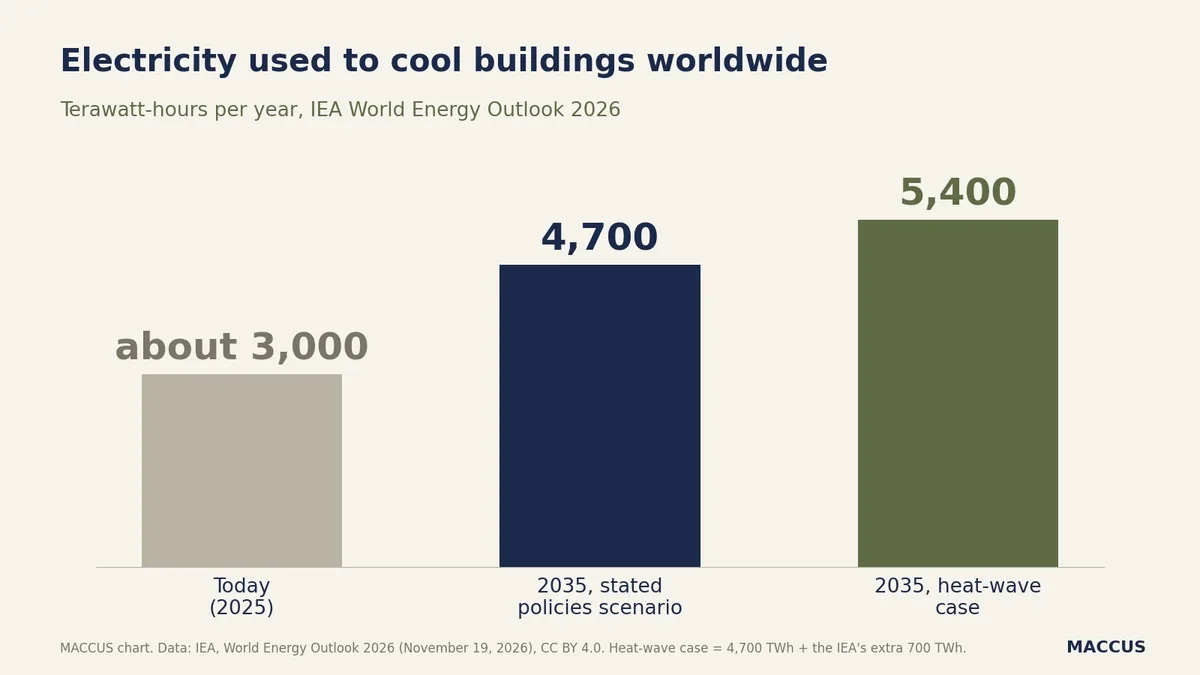
The International Energy Agency (IEA), an intergovernmental agency that advises governments on energy, said on 19 November 2026 in its World Energy Outlook 2026 that the energy needed to cool the world's buildings is overtaking the energy needed to heat them for the first time. Two forces drive this: rising incomes and rising temperatures. In emerging and developing economies outside China, 85% of households are exposed to high temperatures for part of the year, but fewer than one in five own an air conditioner.
In the IEA's main scenario, based on policies governments have announced, electricity used for cooling grows by 1,700 terawatt-hours (TWh)[1] by 2035, from about 3,000 TWh a year to 4,700 TWh. A separate heatwave case adds 700 TWh more. Cooling makes up 12% of the world's electricity demand in 2035 but 30% of peak demand[2], the highest demand a grid must meet during the year.
The milestone is measured in energy services, meaning the comfort delivered, or useful energy[3]: the energy that does the job people want. Heating still uses more fuel and electricity. The article explains that a boiler loses part of its energy, while an air conditioner moves heat and delivers more cooling than the electricity it consumes. The report gives no number for the crossing itself, and the IEA's executive director, Fatih Birol, said none of its scenarios is a forecast.
Read the original maccus.frDiscussion
Discussion
Commenters mostly say cooling fits solar power output better than heating, which is needed on shorter winter days with less sun. Several find the headline misleading, since heating still uses more energy, and others point to richer countries being able to afford air conditioning as a main cause.
Links from the post and discussion
Sources
-
MACCUS
Cooling buildings is overtaking heating them as an energy need, IEA says
-
KRGeekNews KO
IEA, 건물 냉방 에너지 수요가 난방을 추월하고 있음