Computer analysis of Starve the Fox, an asymmetric Norse board game
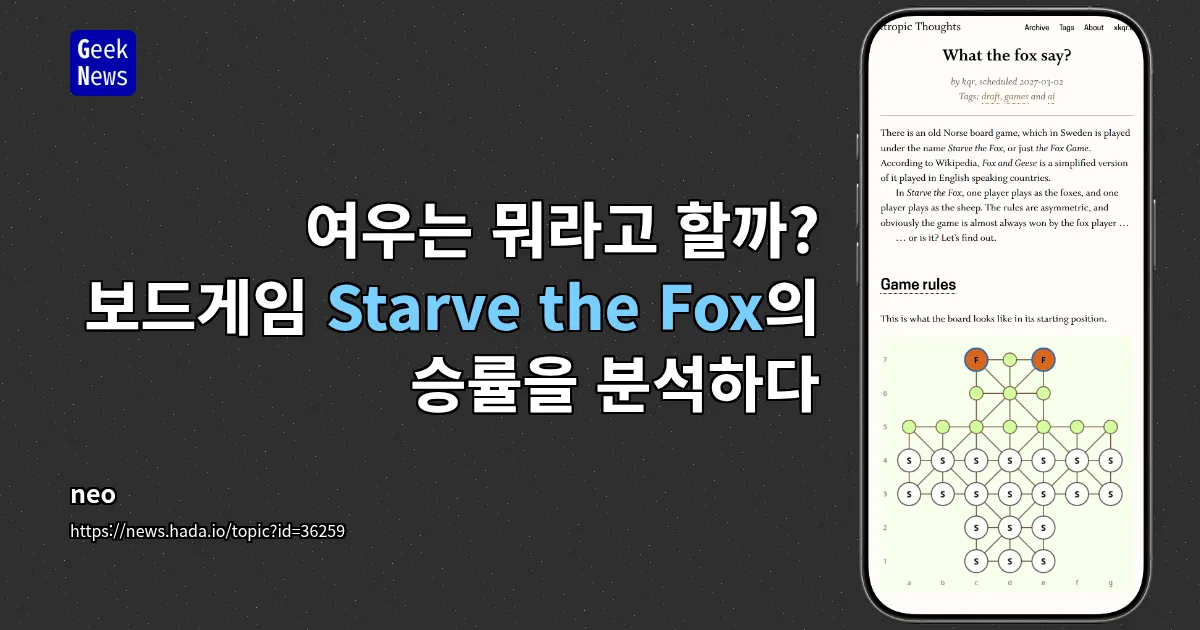
Starve the Fox is an old Norse board game, known in Sweden and related to Fox and Geese, in which two foxes face twenty sheep. The rules are asymmetric: sheep, which can never move backwards, win by filling the top-centre 3×3 pen with nine pieces, or by trapping foxes so they cannot move and removing both of them; the fox moves in any direction, eats sheep by jumping over them, and wins once fewer than nine sheep remain. The fox moves first, but the author's analysis finds the first-move advantage very small. Because the game is loopy, it is counted a draw after 40 moves without progress, measured by sheep rank.
Family wisdom holds that the fox wins unless it blunders badly, and the author, who wrote the rules in Python and hooked them into OpenSpiel's generic tree search, confirmed the tilt: plain Monte Carlo tree search[1] with random rollouts[2], running about 1,000 iterations per second in unoptimised Python with a thinking budget of just under a second, saw around 85 % of self-play games won by the foxes. With a search budget of 8,000 iterations, though, the computer playing sheep exploited two blunders and reached a winning position. This showed that the sheep side needs deeper thinking: individual sheep are so weak that the whole flock must be coordinated over many turns, so the sheep player is really moving the holes in the flock.
To make the computer opponent stronger without long waits, the author truncates rollouts after 8 plies[3] and scores unfinished positions with a heuristic function[4], scaled to weigh less than the win/loss result of a finished game.
Read the original entropicthoughts.comDiscussion on GeekNews
Discussion
Commenters liked how the asymmetry makes the game a good match for children, but noted that the only playable version offered is a set of pre-arranged puzzle positions rather than a game against the computer, and suspected some puzzles are buggy because the check requires a specific fox to make the capture.
Sources
-
KRGeekNews KO
여우는 뭐라고 할까? 보드게임 Starve the Fox의 승률을 분석하다
-
entropicthoughts.com
What the fox say?