Taking apart a 1.4 MB browser shooter: procedural assets, materials and lighting
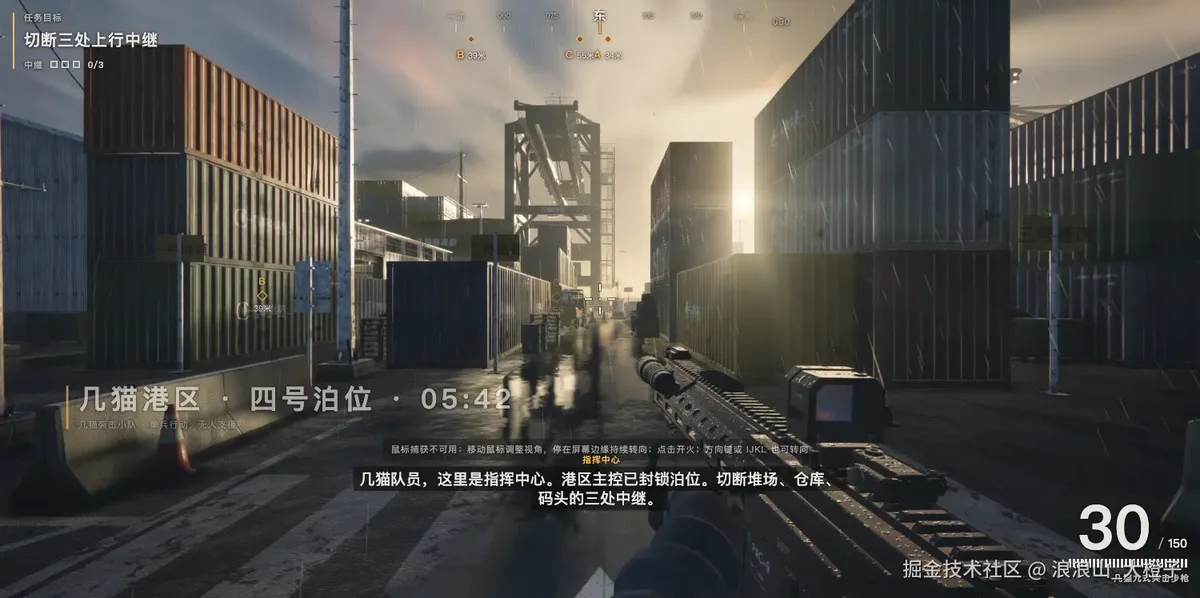
The article analyzes Saltline, a first-person shooter that runs in a browser. It is built with Three.js and packed into one HTML file of 1,425,707 bytes (about 1.43 MB in decimal units). Instead of storing finished assets, it uses procedural generation[1]: geometry is built from parameters, textures are drawn by algorithms, and sound is synthesized from signals. The public mirror credits the original to Felix Rieseberg's Claude Fable 5.2 experiment. The author says the file he received mainly changed the Chinese interface, fonts, title and project introduction.
The author lists 18 techniques. Materials combine noise, scratches and rust, and the sky shader also drives fog and ambient light. Shadows soften with the distance between the blocker and the receiving surface, in the style of PCSS[2], and wet ground changes gradually from dry to standing water. Rain visibility depends on covered areas, and the rifle has its own camera with spring-based recoil.
The mechanical dog's feet are placed with inverse kinematics[3], and HDR brightness is mapped to the screen with tone mapping[4], using ACES and AgX-style curves. Shaders are precompiled before play, and sound is generated in small batches so startup is not blocked. The author also compares the game with his own project, Fog Harbor (雾港). Its 1.0 version uses procedural materials and its offline HTML is 853,360 bytes. He describes differences in asset approach, code organization and navigation.
Sources
-
CNJuejin ZH
被1.4 MB的射击游戏震撼后,我认真拆了一遍Fable的实现