OpenAI says its models improved AMD chip designs and its Jalapeño chip
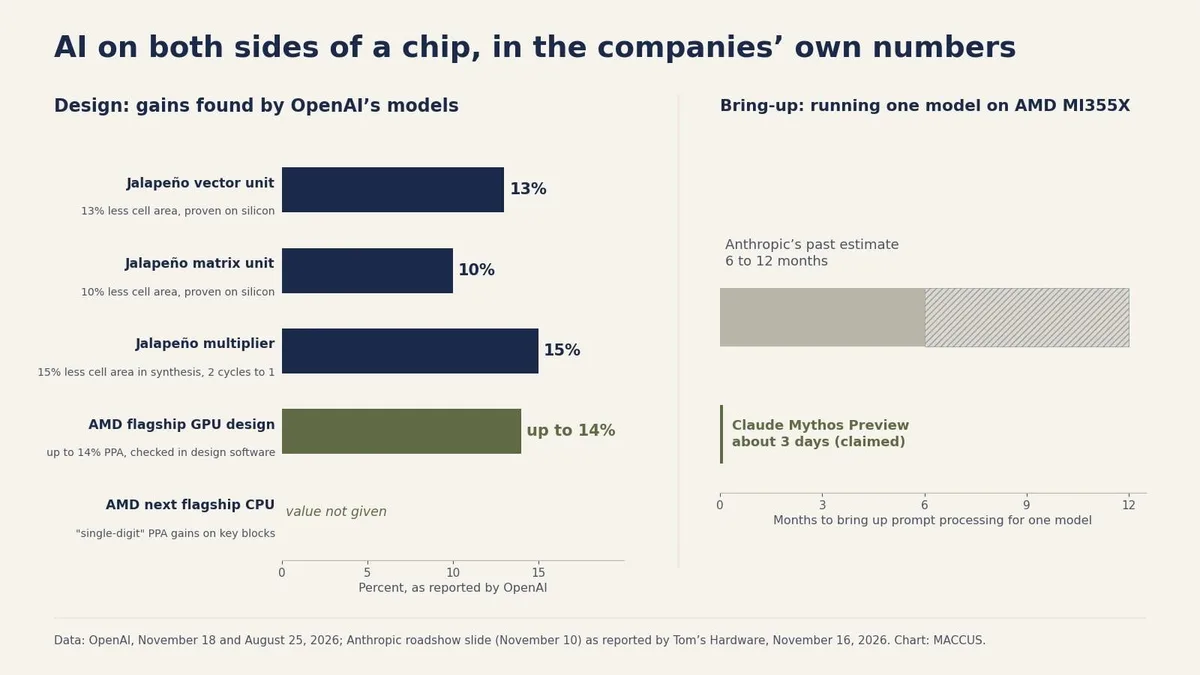
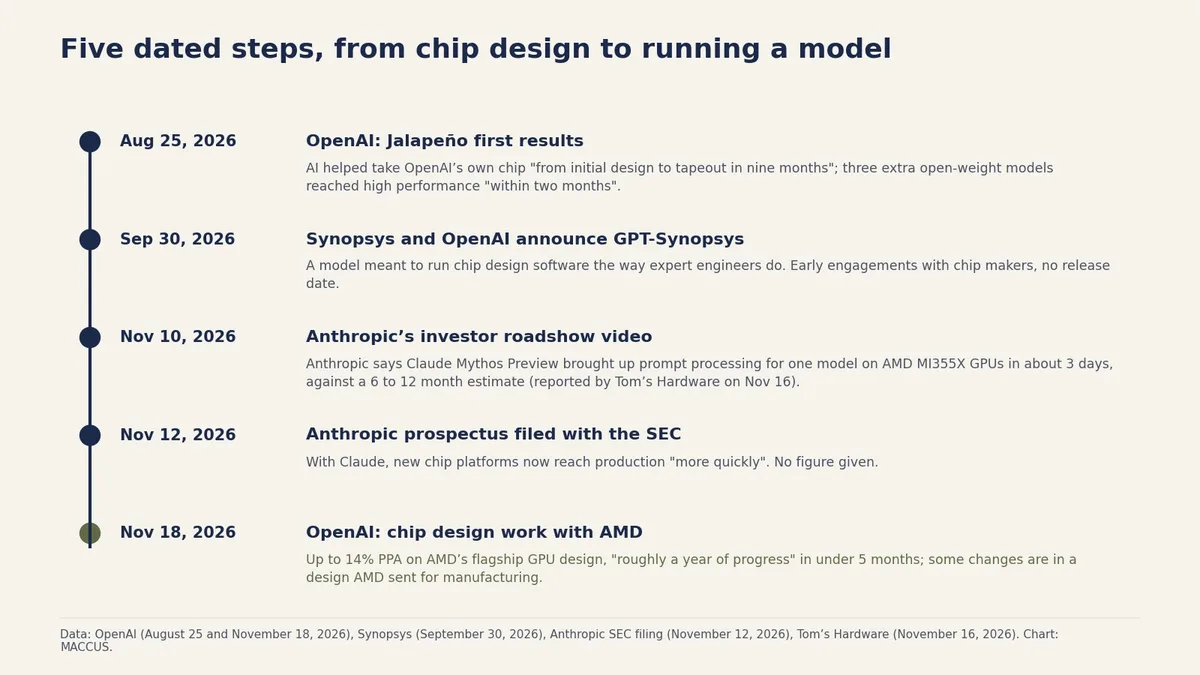
Update · : The article gives the date of OpenAI's announcement as November 18, 2026, and says the AMD gains were achieved in under five months and are equivalent to about a year of progress. It also reports a separate Anthropic claim, made two days earlier in an investor video, that its Claude Mythos Preview model wrote nearly all the low-level code to run one of its models on AMD GPUs in about three days, versus 6 to 12 months for its engineers.
Update · : A 15% cell-area reduction in one multiplier redesign of the matrix unit, with latency cut from two clock cycles to one, and a 15% area reduction in an adder redesign with latency held at two cycles. The RISC-V test used 9,881 scored runs, and a design was scored zero if it failed checks or exceeded 16 times the original core's area.
OpenAI (@OpenAI) wrote on X that its models helped improve chip designs, and shared an article on the results. According to the article, OpenAI's models found PPA[1] improvements of up to 14% on AMD's flagship GPU IP in less than five months, compared with heavily optimized baselines. AMD has already included some of these changes in a recent design sent for manufacturing, and added others to its production design files for future versions. AMD also verified single-digit percentage PPA gains across key blocks of its upcoming next-generation flagship CPU.
The models also contributed to Jalapeño, OpenAI's first custom inference chip, which runs AI models. The team estimates that changes proposed by the model reduced standard-cell area by about 13% in the vector unit and 10% in the matrix unit, and these optimizations were silicon proven during the chip's bring-up. The model also rewrote SystemVerilog RTL[2] code, and Synopsys EDA[3] tools were used to check that each rewrite preserved the block's behavior.
In a separate test, OpenAI gave its models two open-source RISC-V[4] cores, PicoRV32 and Ibex, and asked them to increase throughput. With about 112,000 tokens per run, GPT-6.2 Astra had the highest average score on both cores. OpenAI is also partnering with Synopsys to train a new model, GPT-Synopsys, to use Synopsys EDA tools the way expert chip designers do.
Read the original openai.comDiscussion on OpenAI
Discussion
Commenters on Hacker News were mostly skeptical. One asked why the RISC-V designs were not shared, and another noted that the charts use a "mean normalized reward" with no equation. One called the post advertising and suggested the frequent posts are timed ahead of an IPO, while another wrote that AI may eventually improve circuit design.
Sources
-
OpenAI
Working with @AMD , our models identified up to 14% PPA improvement on flagship GPU IP in less than five months—building on designs AMD’s engineers had already spent years optimizing. The same approac…
-
KRGeekNews KO
OpenAI 모델을 활용한 칩 설계 개선
-
OpenAI
Advancing chip design with OpenAI models
-
MACCUS new source ·
OpenAI says its models found a year's worth of AMD GPU design gains in under five months
-
HKTechapple ZH new source ·
OpenAI 模型改寫晶片電路 AMD 旗艦 GPU PPA 最多升 14%
-
X new source ·
GPT-6.2 Astra is pretty good at hard things. Here the team shared some results on AMD and Jalapeño chip optimizations. I do get the feedback on its communication style and we're working on that, but f…