AI cause prioritization rests on small groups of correlated researchers
A LessWrong post introducing a six-week reading group called 'Doing Good in the Age of AGI'[1] argues that although this decade's actions may be exceptionally important for civilization's future, the question of which problems matter most receives far less research attention than much smaller policy questions. Rent control, back in the public spotlight since Mamdani's rent freeze passed in June 2026, shows what a well-studied question looks like: 82% of renters and homebuyers believe there should be caps on rent increases, yet a survey of top economists found that only 2% think rent caps would make the middle class substantially better off over a decade. The American Economics Association has 23,000 members, about half of them academics, a single meta-analysis on rent control reviews over 200 papers, and climate science published over 15,000 peer-reviewed studies in 2025.
Prioritization work, by contrast, employs very few people: in 2025 GiveWell had about 40 full-time employees answering what is the most cost-effective way to save a life, Animal Charity Evaluators had about 12 FTEs[2], and Coefficient Giving's Global Catastrophic Risks team had 55 people as of October 2026, though not all of them do prioritization work directly. Rethink Priorities estimated in 2025 that only about 20 FTEs worldwide were trying to determine the most important cause to work on and only 4 FTEs were comparing the cost-effectiveness of interventions across causes, with only a fraction of them considering transformative AI. The researchers are also highly correlated: Forethought, an organization with close to 16 FTEs, contributed about 9 required readings and 3 additional recommendations to the curriculum, and only four readings are ones the author is not confident were written by effective altruists[3] — by Eliezer Yudkowsky (the primary founder of the rationalist movement), Jason Hausenloy, the Forecasting Research Institute, and 'The Greater Good Magazine'.
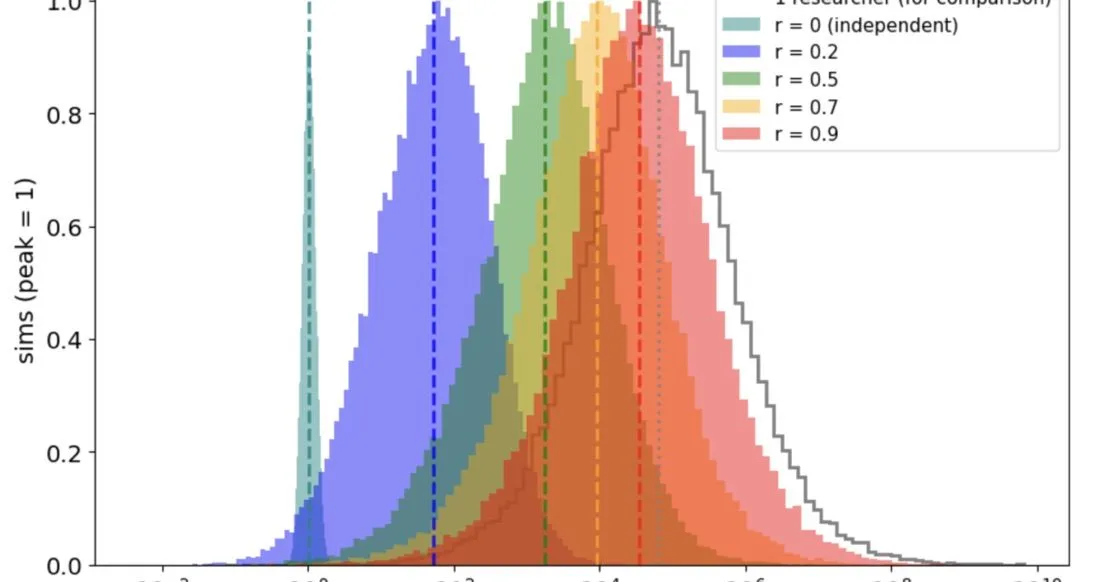
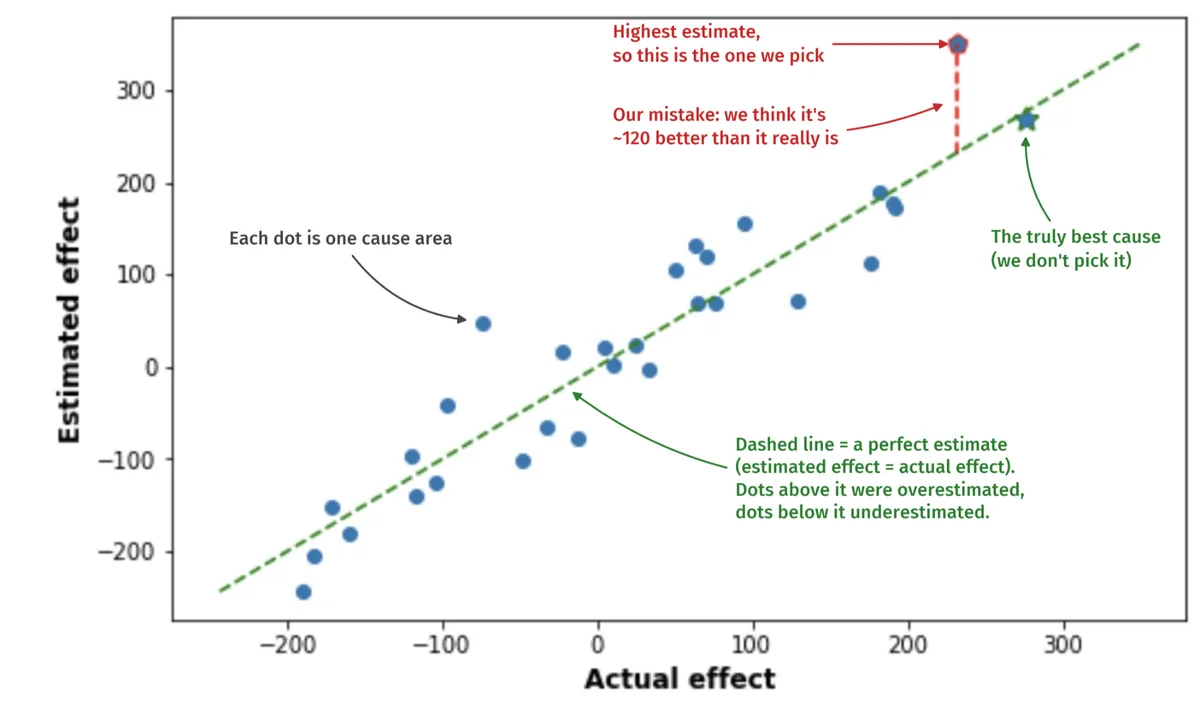
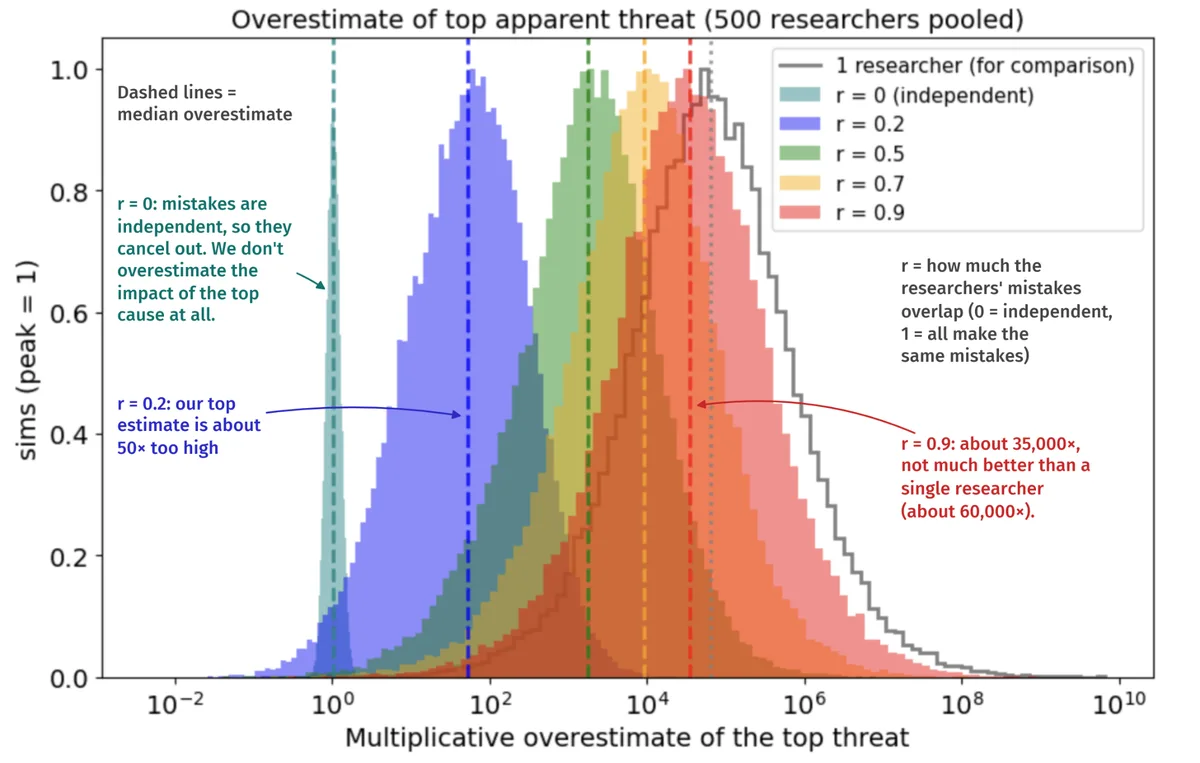
The mathematical worry is the Optimizer's Curse[4]: when comparing roughly 30 cause areas, each estimate mixes a cause's true impact with assessment mistakes, so the top-ranked cause tends to be one whose importance was overestimated, and greater uncertainty amplifies the effect. A diverse pool of independent researchers can reduce this overestimation, but correlated researchers who share the same mistakes cannot remove the curse completely. Using Titotal's Optimizer's Curse model for existential risks, the author simulated 10,000 instances of 500 researchers evaluating causes and aggregating their results: with completely uncorrelated mistakes (r = 0) aggregation leads to no curse most of the time, while researchers who share many of the same mistakes significantly overestimate the top threat most of the time. The author concludes that if AGI or ASI arrives by 2040, most best guesses for a good future will come from small groups of highly correlated researchers — but the field is small enough that a smart person can contribute valuable critiques within a few months, which is why the reading group runs six weeks instead of eight.
Read the original lesswrong.com
Sources
-
LessWrong
Small Groups of Correlated Researchers


