A $300 billion debt wall looms over private equity-backed companies
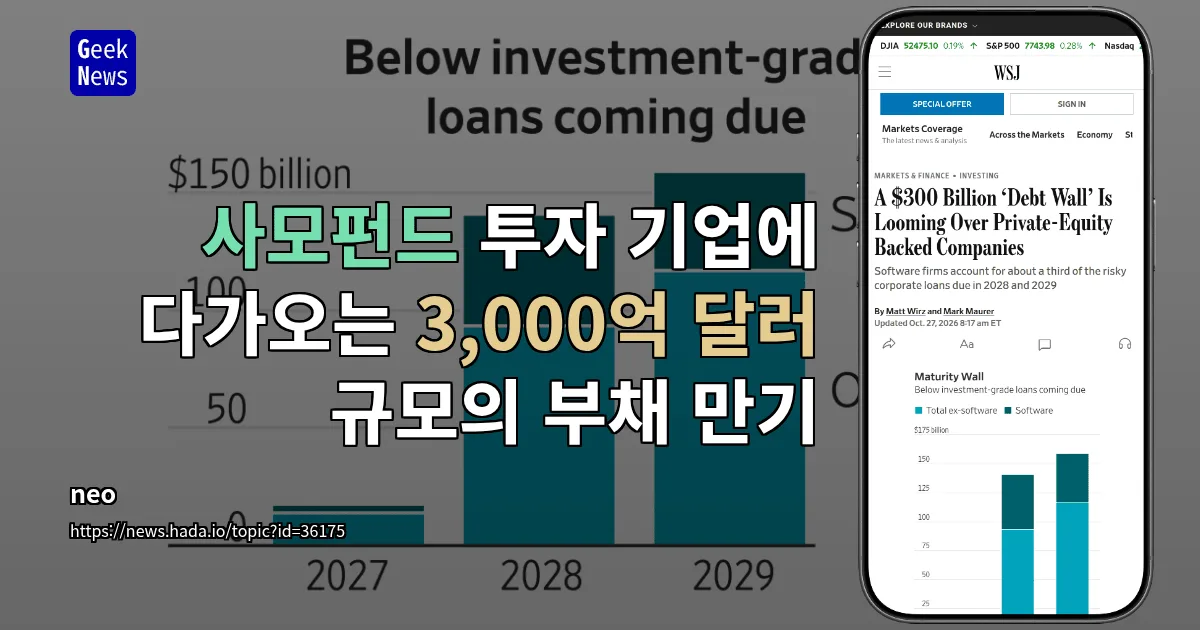
Companies owned by private equity[1] funds hold about $300 billion in loans maturing in 2028-2029 and are rushing to extend maturities to avoid defaults and investment losses. PitchBook counts $140 billion in risky corporate loans maturing in 2028 and $160 billion in 2029, whereas in 2023-2025 loans coming due averaged about $60 billion per two-year span. Companies usually refinance 18-24 months before a large debt matures, but private equity-owned firms are struggling to do so, and the delays are building a concentration of due dates known as a maturity wall[2]. Companies that fail to extend may have to hand control to creditors, and the funds' original equity could be written off entirely.
The debt traces to the low-rate environment of 2021, when private equity buyouts reached a record level — including the $11.8 billion purchase of cybersecurity company McAfee — and much of the funding came as 7-year loans. The US Federal Reserve began raising rates in 2022, making profitable sales of acquired companies harder and new borrowing more expensive. Bank of America projects the default rate on below-investment-grade corporate loans will double to 4% next year with lower recoveries for creditors, while PitchBook reports private equity returns have fallen from about 15% in the ultra-low-rate years to under 10%.
About a third of the 2028-2029 maturities are loans to software companies, about 25% of the remaining loans are rated CCC+[3] or below, and existing software firms face growing uncertainty about their competitiveness against AI companies such as Anthropic, which held a large IPO[4] on Monday. Vehicle maintenance software company Solera, bought by Vista Equity Partners in 2016, carries about $8 billion in loans maturing in 2028-2029 after a planned 2024 IPO did not take place, and its loans trade at 77-93 cents per dollar of face value. Some managers are buying time: Clearlake put an additional $175 million into healthcare software company symplr, and in exchange creditors agreed to extend $2.2 billion in loans to 2030-2031, provide about $100 million more, and let some interest payments be deferred.
Read the original wsj.comDiscussion on GeekNews
Discussion
Commenters tie the situation to the 2018-2022 strategy of buying software that dominates its niche and raising prices; one recounts how, after the screen reader JAWS was bought by the private equity firm Vispero and became pricier, he switched to the free NVDA. They argue such companies employ far more software engineers than big tech, so their troubles may be a real cause of the developer hiring slowdown — a data engineer who spent 18 months job hunting agrees, seeing few openings at traditional tech companies.
Sources
-
KRGeekNews KO
사모펀드 투자 기업에 다가오는 3,000억 달러 규모의 부채 만기
-
wsj.com
A $300B 'Debt Wall' Is Looming over Private-Equity Backed Companies


